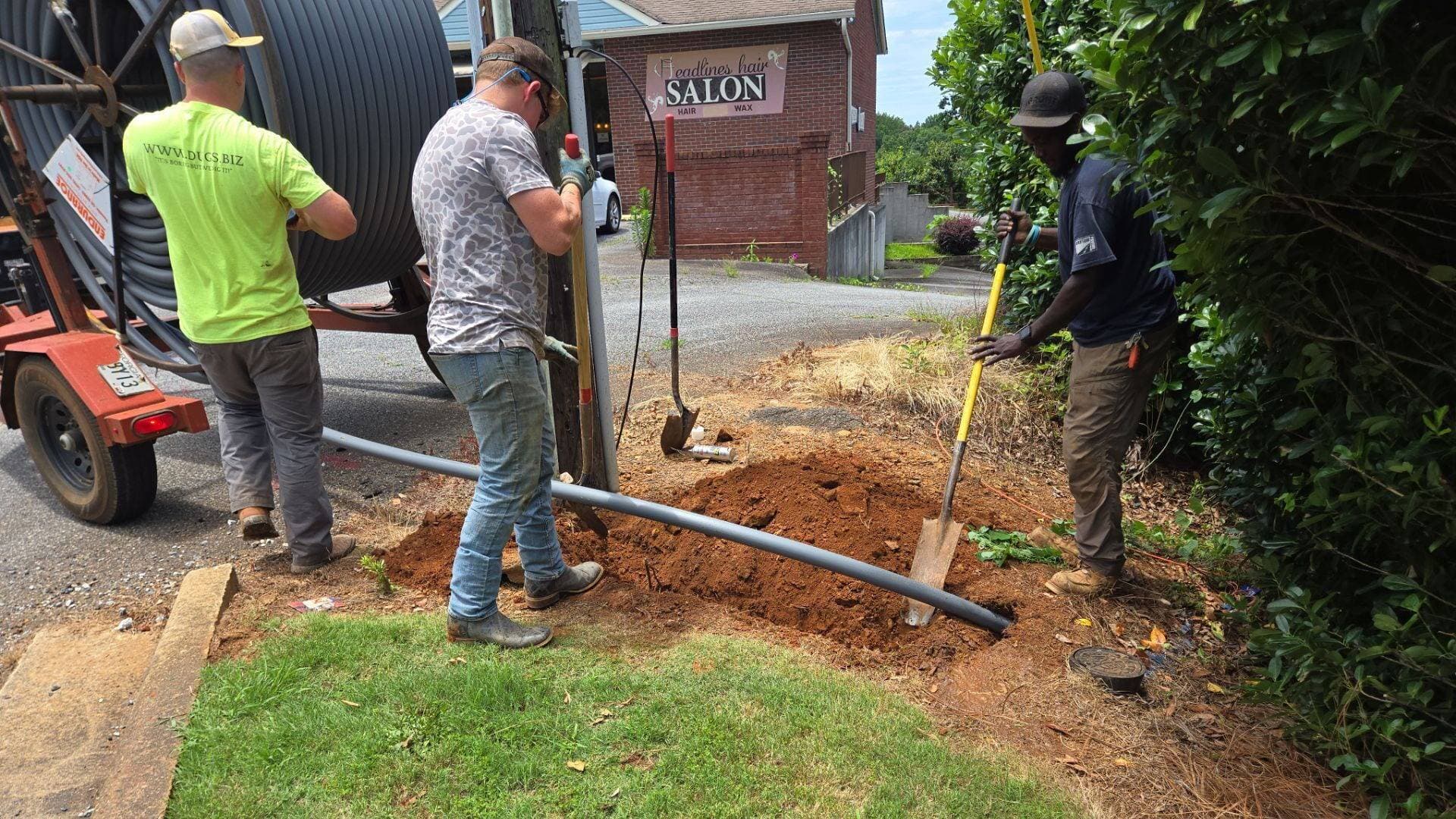
Fiber optic conduit installation by bore: plan the splices first
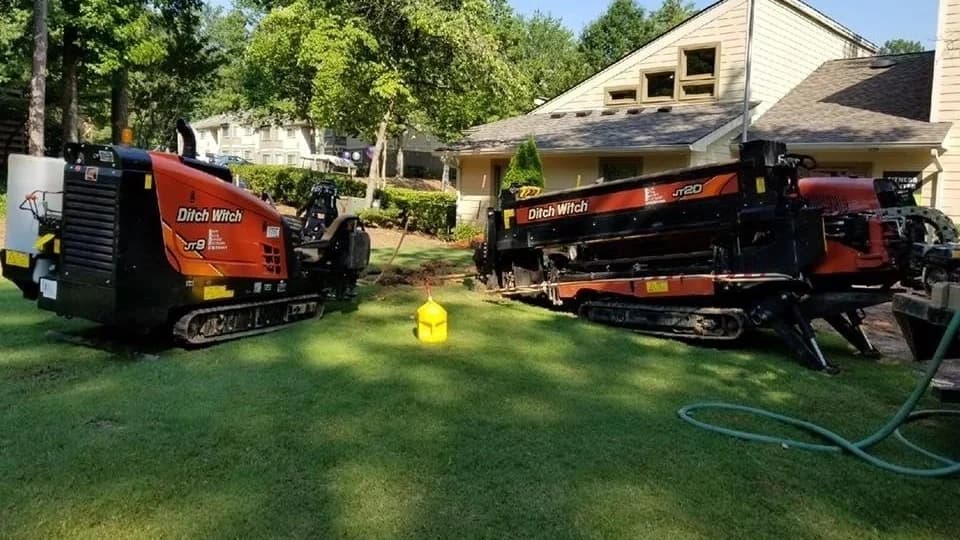
"How deep does it go, and how big a pipe?" is the first question on almost every fiber optic conduit installation call. The sequence answers part of it: steer a pilot bore from pit to pit, ream the hole, pull back the duct bundle, prove each duct with a mandrel, then pull or jet the cable. Bend radius, pull tension and where the splices land decide whether that cable goes in on the first blow or gets cut out.
Fiber optic conduit installation starts with bend radius
Fiber conduit is sized for the pull, and radius governs the pull. Each bend multiplies tension on the cable, so on a fiber optic conduit installation the radius of every sweep gets fixed before the duct diameter does.
PPI’s Handbook chapter on duct and conduit sets the minimum cold bend radius in its Table 7, which is written for pipe installed in open cut trench: 20 times the pipe OD for DR 7 through DR 9 walls, 25 times for DR 11 and DR 13.5, and 27 times for DR 17 and DR 21. The chapter lists 2‑inch IPS duct at 2.375 inches OD, so the DR 11 rule works out to about 59 inches. Go tighter and the duct ovalizes or kinks. On a bore, PPI’s coiled conduit guide TN-58 tells installers to use the largest bend radius possible during placement.
The cable usually hits its limit first. PPI puts typical unassisted fiber pulls under 1,000 feet because of the glass’s "low" tensile strength, while push-blow jetting can pass 5,000 feet in good conditions because air carries the load. On a long run, plan to jet.
HDPE off the reel holds its coil memory, so crews lay it out in line with the bore and let it straighten. Duct pulled in curled sits in the hole as a slow helix.
Why several small ducts beat one big one
One cable in a bare 2‑inch duct looks efficient on the bid. The next cable rides on top of the first, catches at every sweep, and the fill tables already count the duct as full. Subdividing costs least on the day the duct goes in.
PPI reproduces the NEC fill tables: 53% maximum fill for one cable, 31% for two, 40% for three or more, with a jam ratio between 2.8 and 3.2 to avoid on three-cable pulls. Air-blown fiber follows another rule, an OD-to-ID ratio of 50% to 75%, so a microduct sized to the cable blows farther than a big duct full of air.
The pathway options, bare duct first:
| Pathway | What it is | Fits best | Watch-out |
|---|---|---|---|
| Bare HDPE duct, 1.25 to 2 in | One smooth-wall carrier, no subdivision | Short laterals, one cable ever | Second cable rides on the first |
| Rigid innerduct | Small HDPE ducts pulled into a carrier | Retrofits into existing telecom casing | Eats carrier area fast |
| Microduct bundle | 5 to 27 mm OD tubes under one oversheath | FTTH distribution, phased builds | Needs a jetting crew and clean ends |
| Fabric innerduct (Maxcell type) | Woven textile cells, flat when empty | Adding cells to an occupied duct | Cells sized to the cable, order to match |
| Cable-in-conduit (CIC) | Cable factory-installed in the duct | Long rural runs, one shot | No spare pathway unless a second duct rides along |
NEMA TC 7-2021 covers this duct as a buried or concrete-embedded raceway, and ASTM F2160 covers polyethylene conduit, duct and innerduct for fiber and power cables. Put both on the drawing and hold the supplier to a printed DR.
Past a short lateral, pull nothing into a bare duct. A single cable jetted into an empty 2‑inch pipe leaves the owner buying a new duct the first time a second route is needed, and on a BEAD-funded fiber optic conduit installation that second route is likely.
Where handholes and vaults go, and why spacing is a tension budget
A handhole is where pull tension resets to zero, where the splicer works, and where the bore starts and ends. Put one at every splice point, at every direction change sharper than a sweep can carry and on both sides of every road crossing, then fill the gaps at whatever interval the tension budget allows.
GDOT’s ITS-51C standard detail caps pull boxes on ITS conduit runs at 750 feet apart, with the smaller Type 2 boxes at 200 feet. A fiber optic conduit installation with three sweeps between boxes needs the boxes closer.
Land the exit pit a few feet past the box so the duct comes up on a sweep. A crew that comes up long forces an elbow, and every later pull stalls there.
Tracer wire, sweeps and the locate test a fiber optic conduit installation has to pass
Under O.C.G.A. 25-9-7(g), facilities that owners and operators install on or after January 1, 2001 must be locatable using a generally accepted electronic locating method. The law names no method. On plastic duct the usual answer is tracer wire, continuous and bonded, or locatable duct, or marker balls.
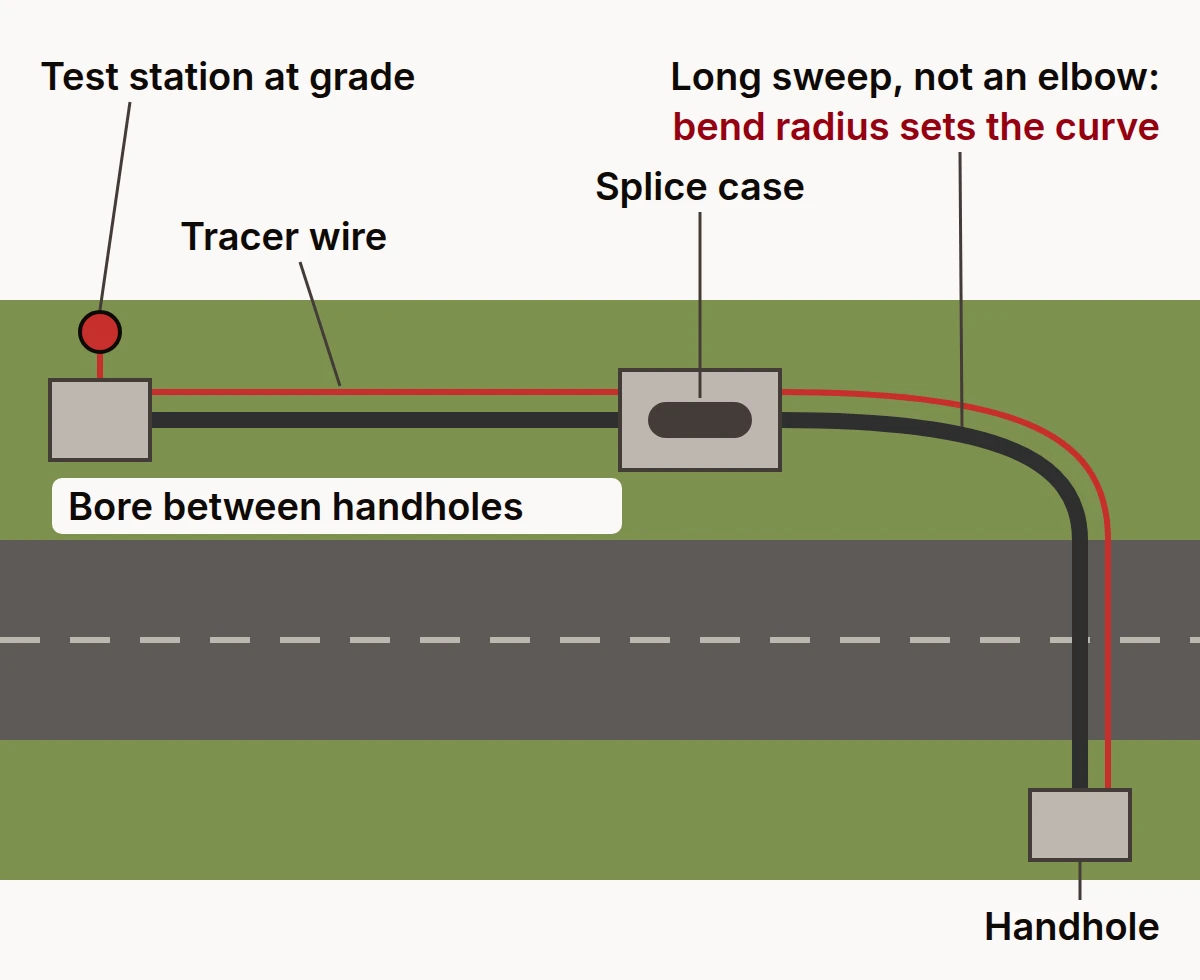
PPI’s chapter describes locatable duct with a copper wire extruded into or onto the wall; on a bore the alternative is tracer wire pulled back with the bundle. Either way the wire surfaces in every handhole and lands on a test station the locate crew can reach without opening a splice case.
Sweeps, not elbows. A molded 90 sits far under the 25 times OD radius PPI gives for DR 11 duct, and a jetted cable stops dead in it.
When the bore crosses existing lines, those lines get marked through the locating steps before any bore and the statute’s tolerance zone applies: the width of the facility plus 18 inches on either side of its outside edge. Inside it the law requires the excavator to exercise reasonable care, including at least one of hand digging, pot holing, soft digging, vacuum excavation, pneumatic hand tools or other technical methods; other mechanical methods may be used with the approval of the facility owner or operator. For directional drilling, the Georgia 811 Excavator Manual (2025) says crews "must always properly expose each utility facility crossing" and that many damages come from failing to pothole them.
Plan the bore path around the splice points
On a fiber optic conduit installation the drill goes where the splices say it goes. Splice points fix the handholes, handholes fix the bore entries and exits, and the path fills in between under the road, the parking lot, the creek or the landscaped quad. Reverse that order and the splicer works in a pit the drill operator chose at seven in the morning.
PPI calls conduit bores mini-HDD, up to 8 inches and 1,000 feet, and recommends SDR 9 to 13.5 walls for horizontal bores (Table 6). Its specifier course puts HDPE yield at a 3,000 psi minimum, the base for safe pull strength on a conduit pull. On depth, the same chapter notes that most conduit burial depths are a maximum of 36 inches; the crossing permit and the owner’s drawing set the cover on each crossing.
A bore is a curve. Steering corrections add radius changes the drawing never showed. A contractor can commit to the entry, the exit, the depth of cover and the duct count. Nobody can promise a finished bore with no bend tighter than planned, and how a bore runs from pilot to pullback shows where the pits and potholing fit.
Prove every duct after pullback with a mandrel and pull tape; proving a duct bank run works the same way. A duct that fails the mandrel can mean a re-bore.
The federal money behind fiber optic conduit installation in rural Georgia
NTIA’s BEAD program is a $42.45 billion grant program, and in the state allocations NTIA announced in June 2023 Georgia’s share is $1,307,214,371.30. The final proposal commits $304.6 million of it to deployment, and most of the new pathway goes to the 91,336 locations slated for fiber.
Updated November 5, 2025, Georgia’s BEAD final proposal overview counts 119,814 eligible locations: 91,336 (76.2%) on fiber to the premises, 14,804 (12.4%) on hybrid fiber-coax and 13,674 (11.4%) on low earth orbit satellite. The average BEAD cost is $2,543 per location, with provider match averaging $4,364 on top.
The FCC’s March 2024 Section 706 report sets the demand side: it raised the fixed benchmark to 100/20 Mbps and found that, as of December 2022, fixed terrestrial broadband had not reached about 24 million Americans, including almost 28% of people in rural areas.
A fiber optic conduit installation paid for by a grant has to carry the next twenty years of cable, so the duct count set at the bore is the one the owner lives with.
What to send a bore contractor, and what the splicer needs back
A fiber optic conduit installation is priced from the drawing, so send the plan sheets with splice points and handholes marked, the duct schedule and the cable spec. In return the conduit crew owes the splicer a pathway that is proven and documented.
Send the bore contractor:
- Plan and profile with every splice point and handhole numbered
- Duct schedule: count, size, DR, microduct or innerduct, tracer wire
- Cable spec sheet with rated tension and minimum bend radius
- Depth of cover, crossing permits and 811 ticket status
- Testing and as-built requirements
What the splicing crew needs back:
- Mandrel passed, pull tape in, duct blown clear
- Every duct end capped and tagged with its route
- Slack coiled to the length on the drawing
- Tracer wire surfaced and tested end to end
- As-builts with footages and depth at every crossing
DUGS lists fiber optic conduit installation, pull and splice box installs and Maxcell installation among the underground services it runs, and Matt prices the work himself after reviewing the plans.
Frequently asked questions
What size conduit is used for fiber optic cable?
In common practice, outside plant fiber rides in HDPE duct between 1.25 and 2 inches, subdivided with innerduct or microduct. PPI’s specifier course on HDPE conduit uses a reel of 2‑inch IPS conduit as its example product and notes that ASTM F2160 covers trade sizes from one half inch to 12 inches. Size the duct from the cable OD and the fill rule for the install method, because a duct that is mostly air blows worse than one sized to the cable.
How is fiber optic conduit installation done under a road?
Under a road, fiber conduit goes in by horizontal directional drilling: a pilot bore is steered under the pavement from an entry pit to an exit pit, a reamer opens the hole on the way back, and the HDPE duct bundle follows it in. PPI’s coiled conduit handling guide, TN-58 shows conduit going in by HDD off the reel and tells installers to use the largest bend radius possible during placement to keep pulling tension down. The duct is proven with a mandrel before the pits close.
What is innerduct used for?
Innerduct splits a big conduit into several small, continuous pathways, so each fiber cable gets its own route and later cables never ride over earlier ones. ASTM F2160 covers polyethylene conduit, duct and innerduct for the protection of fiber optic and power cables. Rigid HDPE innerduct is pulled into existing telecom casings or new carrier duct, fabric innerduct (the Maxcell type) is a woven textile that lies flat until a cable fills it, and microduct is the small-bore version built for jetted cable.
How far apart should handholes be?
Handholes go where the design needs them first, at every splice point, every bore entry and exit and every sharp bend, then at whatever interval keeps pulling tension inside the cable rating. GDOT’s ITS-51C standard detail caps pull boxes on ITS conduit runs at a maximum of 750 feet apart, with the smaller Type 2 boxes at 200 feet, a useful public benchmark for any fiber route. Jetted cable in a straight microduct can go farther between boxes. Pulled cable through several sweeps should go shorter. Size the box for the slack coil as well as the duct count.
Does fiber conduit need tracer wire?
In Georgia it has to be locatable, and tracer wire is the usual way to get there. HDPE duct and dielectric fiber cannot be found with a standard locator, and the Georgia Underground Facility Protection Act requires facilities that owners and operators install on or after January 1, 2001 to be locatable using a generally accepted electronic locating method, as Georgia 811’s law page summarizes it. The law names no method. A tracer wire pulled back with the duct and brought up in every handhole is the usual way a fiber run meets that requirement; locatable duct and marker balls are other ways.
Can fiber be installed in the same trench as power?
It can, under rules that depend on who owns the plant. IEEE’s National Electrical Safety Code is the utility-side code, and its Part 3 covers supply and communication cables and equipment in underground or buried systems. On private property the National Electrical Code governs instead, and the engineer of record decides which applies. On a bore the question is simpler: a joint bore pulls a power duct and a fiber duct in one bundle only when the design allows it, and the two normally get their own ducts, spacing and handholes.