Georgia 811 and utility locating: the ticket is a floor, not a plan
“You called 811, so we’re covered, right?” A superintendent asks that on most jobs, and the answer is: covered for the lines the members own, up to the meter, to the accuracy of paint. In Georgia the ticket is the legal floor. Utility locating for a bore is everything you do on top of it, because a drill head passing under a marked gas main is a different problem from a backhoe bucket.
Georgia 811 sets the floor: notice, positive response and the 30‑day clock
Before any mechanized excavation in Georgia, a directional bore included, the excavator files a locate request with Georgia 811, waits out the notice period unless every member answers sooner, checks the positive response system, and only then breaks ground. That sequence is the legal minimum. Nothing in it says the paint is where the pipe is.
Under O.C.G.A. 25-9-3, reproduced on Georgia 811’s law page, the notice period starts at 7:00 a.m. on the first business day after Georgia 811 receives the request and runs not less than two and not more than eight business days. If every member answers in PRIS, the positive response system, that it is marked or clear, work may start early. A normal request expires 30 calendar days after its effective date.
The excavator keeps the marks visible, and stops and notifies Georgia 811 and the owner if the equipment strikes, damages, injures or loosens a facility. If that line carries gas or a hazardous liquid, the law requires an emergency 9‑1‑1 call.
The Excavator Manual counts dents, scratches and gouges as damages. A gouged gas service that gets buried and forgotten is the one that fails in February.
Utility locating starts with reading the paint correctly
Paint on the ground is a claim about horizontal position, made by a member locator, for public facilities only, on the day it was sprayed. The colors follow the APWA Uniform Color Code, and a crew lead should know them cold.
| Color | APWA meaning | On a bore job it is usually | How it gets found |
|---|---|---|---|
| White | Proposed excavation | Your bore route, painted before the ticket | You paint it |
| Pink | Temporary survey markings | Property pins, alignment, grade stakes | Surveyor |
| Red | Electric power lines, cables, conduit, lighting cables | Primary and secondary feeds; lighting past the meter is private | EM on the conductor |
| Yellow | Gas, oil, steam, petroleum, gaseous materials | Mains and plastic services with tracer wire | EM on tracer, then pothole |
| Orange | Communication, alarm or signal lines, cables, conduit | Telecom, CATV, fiber innerduct | EM; GPR if no tracer |
| Blue | Potable water | Mains and services; old PVC with no tracer tones nothing | EM if metallic, else pothole |
| Purple | Reclaimed water, irrigation, slurry lines | Irrigation mains, nearly always private | Private locate |
| Green | Sewers and drain lines | Laterals and storm; clay or PVC, often unlocatable | Sonde in the pipe, or pothole |
Paint does not carry depth: Georgia 811’s manual says neither the owners nor Georgia 811 has depth information. Marks in red clay after a week of storms are a rumor. Photograph the original marks before the first pass and refresh them with your own paint and flags, because mark maintenance is on you.
Utility locating on the public side stops at the meter
Member locators mark the lines their utility owns, usually to the meter. Everything downstream is private, and it is what a bore path crosses on a commercial site: irrigation mains, site lighting, gas to a grill, fiber between buildings.
Georgia 811’s page on whether your lines have been marked is blunt: member technicians “will only locate public utilities and not private utilities, as private utilities are the responsibility of the property owner.” The manual adds that three-phase commercial services are typically customer-owned from the transformer to the building.
On a developed parcel, private utility locating comes before the bore plan. PRIS saying marked tells you nothing about a 480-volt feed to a lot pole. Related questions are in how to choose an underground utility contractor in Georgia.
What electromagnetic utility locating finds, and where GPR gives up in clay
An electromagnetic locator finds conductors carrying a signal: metal pipe, cable, tracer wire, or a transmitter inside a pipe. Ground penetrating radar sees any change in the ground, metallic or not, but only as deep as the soil allows. Clay shortens that reach, and plenty of Georgia sites sit in clay.
What EM misses is anything non-conductive. FHWA’s guide to site characterization and utility locating lists PVC, fiberglass, vitrified clay and metal pipe with insulated joints among utilities EM methods may not detect, and untraced plastic water services are the everyday case. The locator paints those from the meter box toward the main by dead reckoning. That line is a guess wearing blue paint.
FHWA also covers getting the signal on: direct connection at an exposed point, induction from a transmitter or clamp, or a sonde or fish tape pushed inside non-metallic pipe. In a congested corridor an induced signal bleeds onto the neighbors, so good locators hook up direct wherever they can.
GPR helps, but FHWA says its depth of detection typically drops as clay content rises, so utilities buried greater than 2 to 4 feet may not be detectable. The bore itself is covered in horizontal directional drilling explained.
Pothole every crossing before the head passes
Potholing means daylighting the utility with a vacuum excavator so you can see the pipe and measure its depth and diameter. It is the last step of utility locating and the only one that shows you the depth instead of assuming it. On a bore, every marked crossing gets potholed. All of them.
In Georgia that practice is written down. Page 21 of Georgia 811’s 2025 Excavator Manual, under “Directional Drilling: Excavating with Reasonable Care,” says directional boring or drilling excavators “must always properly expose each utility facility crossing,” that GUFPA requires everyone drilling or boring to comply with the Common Ground Alliance Best Practices, and that “many damages occur as a result of failure to pothole these crossings.” It adds that with any trenchless technique “it is important to expose all sides of the underground utilities.”
In the tolerance zone the law requires reasonable care, including at least one of the listed methods, potholing and vacuum excavation among them, plus additional care for trenchless work. OSHA 1926.651(b)(3) agrees: “the exact location of the installations shall be determined by safe and acceptable means.”
Expose to the bottom of the pipe, not the top, because the clearance that matters on pullback is measured from the reamer, which is bigger than the pilot head, and a reamer that clips the invert of a sewer is a sewer replacement. Log depth, diameter and offset from the paint before the first rod goes in. When the paint is off by a couple of feet, that entry is what the damage investigation runs on.
Potholing only finds what somebody knew to mark. An abandoned duct bank with no tracer will not tone, and GPR may miss it. We review utility markings, verify locations as needed, and plan the bore path around existing infrastructure and required clearances. Entry and exit pits and utility potholing may still be required.
What actually breaks lines: the 2024 DIRT Report numbers
Buried utilities get hit for a short list of reasons. The Common Ground Alliance’s DIRT Report finds the ten leading root causes cover 85% of damages, and three of the causes CGA highlights are utility locating and verification failures.
The CGA 2024 DIRT Report analyzed 196,977 unique damage reports for the 2024 data year. In its root cause analysis, no notification to 811 accounted for 24.54% of damages and failure to keep clearance after verifying the marks 16.07%. Locator error left a facility unmarked in 11.94% and marked it inaccurately in 8.58%. Digging before potholing the marks was 4.94%; faded or lost marks, 2.17%.
The two locator-error bars mean roughly one damage in five came with a ticket in hand and paint that was wrong or missing. Add the clearance and potholing bars for another one in five: marks in hand, not verified or not respected. The pothole is the step that catches those.
The bore-day sequence that keeps the ticket honest
In utility locating the order matters as much as the steps: white-line, ticket, wait, PRIS against the ground, private locate, pothole, then the path. Crews that pothole after the pilot bore has started are verifying a decision they already made.
- White-line the route before the ticket. Under the PSC rule quoted in the manual, a single-path white line “shall be located for twenty (20) feet on either side of the white line” and 20 feet past its start and end.
- File the locate request and let the notice period run, and settle early who files it. We coordinate required 811 notifications before drilling. Permit responsibility varies by project and is confirmed during the quoting process.
- Check PRIS the morning of and walk the site. A member that has not responded gets a second chance that, per the manual, “begins at 7:00 a.m. and ends at 12:00 noon on the day the locate request becomes effective.” After noon, the manual says to file an additional request and wait if there are obvious signs of unmarked lines or any utility is still silent in PRIS. The statute lets you proceed with reasonable care only when there is no visible and obvious evidence of an unmarked line. On a bore, we wait.
- Run private utility locating downstream of the meters and the transformer.
- Pothole every crossing to the bottom of the pipe and set the profile to measured depths, not design depths. If potholing cannot find a marked line, the manual says to notify the owner, fix the precise location together before continuing, and file an additional request.
- Keep the marks alive, and get a new request in before the 30‑day request life runs out.
The step-by-step is in how a directional bore day actually goes, and the rest of our work is on the services page.
There is a full breakdown of this topic in Fiber optic conduit installation by bore: plan the splices first.
Frequently asked questions
Do I need to call 811 before directional boring?
Yes. Georgia’s dig law defines excavating as any operation using mechanized equipment to move earth below grade and names boring and drilling, so a directional drill needs a ticket. Georgia 811’s process page says to dig only once every utility has responded marked or clear and there are no visible and obvious signs of an unmarked line. On a bore the ticket is only the start: a private locate and a pothole at each crossing come before the pilot head goes in.
How long does a Georgia 811 ticket take?
Plan on three business days. Georgia 811’s process page says to submit at least 3 business days before digging, and members get at least two full business days after the day you submit to mark. O.C.G.A. 25-9-3, which Georgia 811’s law page reproduces in full, starts the notice period at 7:00 a.m. on the first business day after the request is received and sets business hours at 7:00 a.m. to 4:30 p.m. The Excavator Manual adds that a request entered after 4:30 p.m. counts as entered the next business day. If every member responds early, you may start early.
What is the tolerance zone?
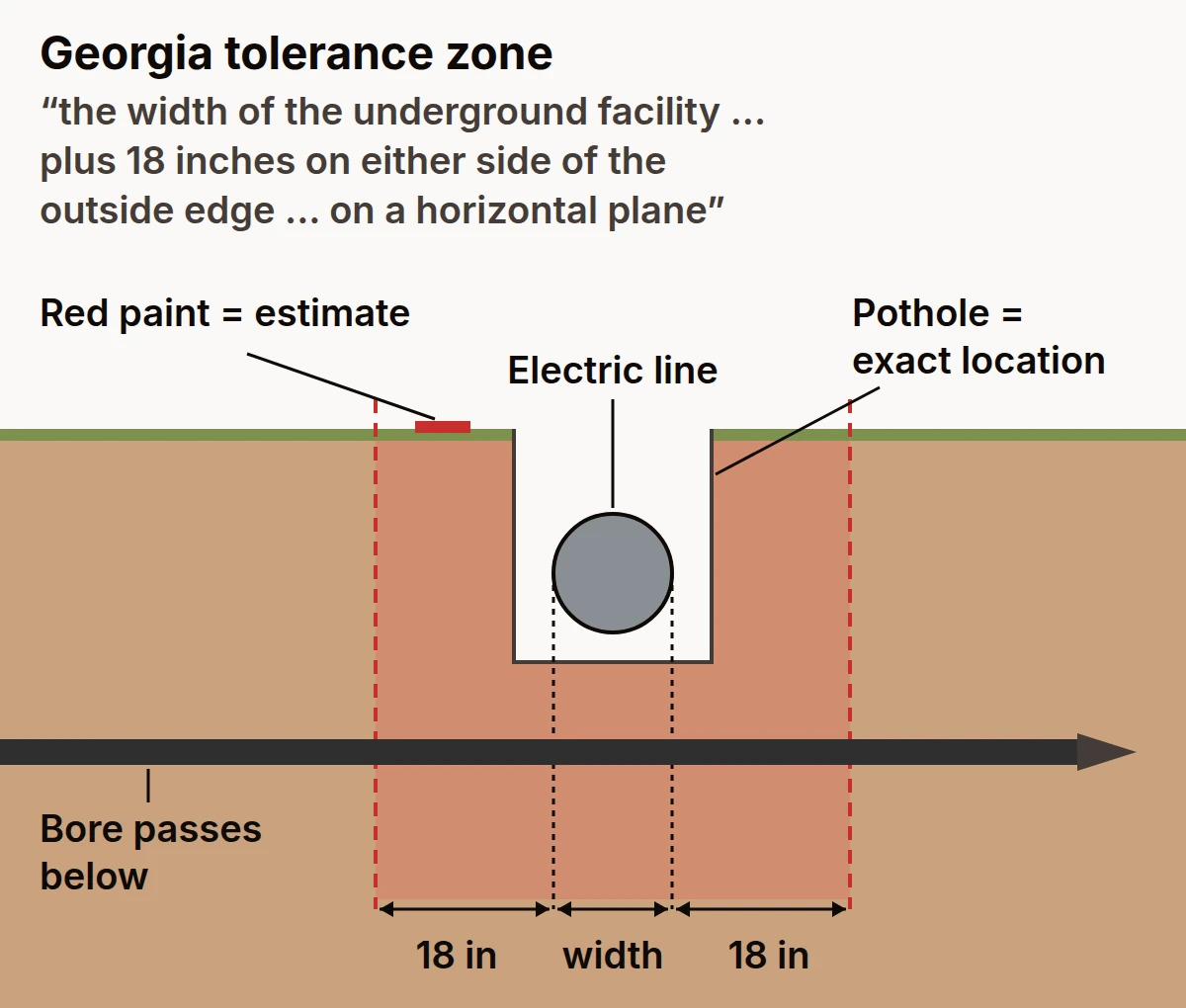
Georgia’s tolerance zone is the width of the underground facility plus 18 inches on either side of its outside edge. It is measured from the pipe, not the paint, so Georgia 811’s excavator manual shows a 40‑inch zone around a small pipe and 46 inches around a larger one. Inside the zone the law requires reasonable care, including at least one of: hand digging, potholing, soft digging, vacuum excavation, pneumatic hand tools or other technical methods. On a bore, the manual says expose every crossing.
Does 811 mark private utilities?
No. Georgia 811 members locate only the facilities they own, which usually end at the meter, transformer, vault or valve serving the property. Irrigation, parking lot lighting, propane, gas to a grill, the private side of a sewer lateral and three-phase feeds from the transformer to a building are private and are not marked on a standard ticket. Georgia 811’s positive response codes flag it: codes 2B and 3H tell the excavator that privately owned facilities are on the property and to contact their owner. A private utility locating company usually does that work. Ask the property owner for as-builts as well.
What is potholing?
Potholing, also called daylighting, is exposing a buried utility, usually with a vacuum excavator using air or water, so you can see and measure the line. It is the step of utility locating that gives a measured depth instead of an assumed one. FHWA’s subsurface utility engineering program ranks it as Quality Level A, the highest accuracy available; designating with EM or GPR is Quality Level B. On a bore every marked crossing is potholed before the pilot head reaches it.
What do the paint colors on the ground mean?
Georgia 811’s Excavator Manual lists the APWA Uniform Color Code the marks follow. Red is electric power and lighting cables. Yellow is gas, oil, steam, petroleum or gaseous materials. Orange is communication, alarm or signal lines, cables or conduit. Blue is potable water. Purple is reclaimed water, irrigation and slurry lines. Green is sewers and drain lines. Pink is temporary survey markings, and white is the proposed excavation, the outline you paint before the ticket goes in. Paint shows horizontal position only. None of it tells you depth, which is why each crossing still gets potholed.