Auger boring vs directional drilling for cased road and rail crossings
“The county wants a 36‑inch casing under the road with the sewer on grade. Can you just drill it?” Usually not. A directional drill steers, goes long and goes deep, but it will not hold a gravity grade through a straight casing to a half inch. That job belongs to auger boring: steel casing jacked from a pit while an auger clears the spoil.
How auger boring works: pit, track, casing, auger
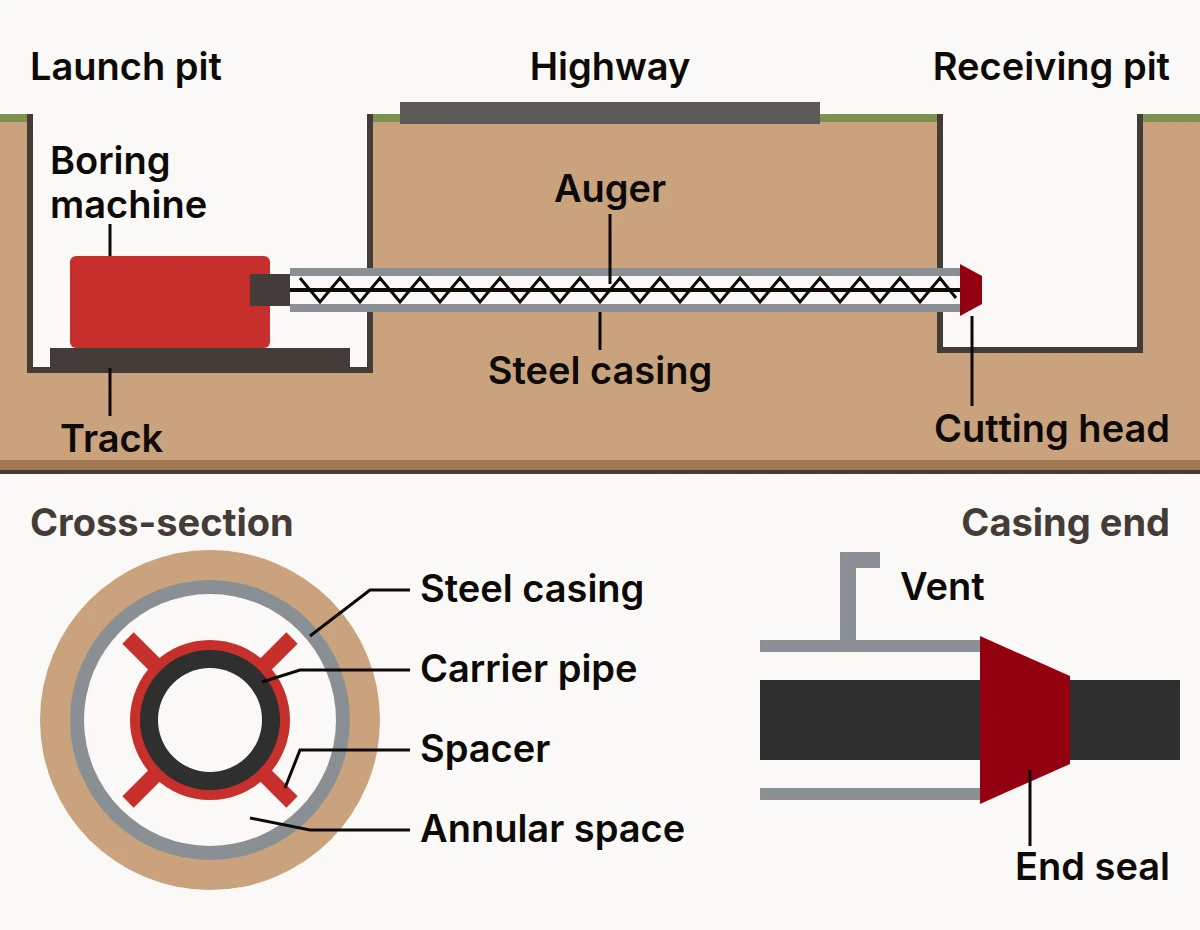
Jack and bore is a straight-line method. A boring machine on a track in a launch pit pushes a stick of steel casing toward a receiving pit and turns an auger inside it, so the cutting head breaks ground and the flights carry spoil back.
FHWA’s 2002 utility-cuts manual gives auger bores 4 to 60 inches, drives up to 890 feet and 3 to 40 feet per hour. Its setup starts with a shaft, a foundation and a thrust block.
Good crews spend longer on the track and the first stick of casing than on the rest of the drive, because nothing after the second weld can steer a plain auger bore. In wet ground they run the cutting head a hair inside the casing lip so the face cannot run in ahead of the pipe. FHWA calls subsidence the most common auger boring problem and blames an oversized hole or soil entering the end of the casing.
The launch pit sits below the casing invert, because the machine and track go under it. OSHA’s excavation rule at 29 CFR 1926.652 requires a protective system unless the excavation is entirely in stable rock, or under 5 feet deep and a competent person finds no indication of a potential cave-in, so at road-crossing depth the pit is a shored box.
There is a full breakdown of this topic in What is directional boring? How a bore day goes, step by step.
How directional drilling does the same crossing
A directional drill needs no pit for the machine. The rig sits on the surface, drills a steerable pilot hole along a designed arc, then reams it in passes. The product is usually the carrier itself, fused or welded into one string, with no casing.
The full bore day is in how horizontal directional drilling installs a line without a trench. PPI’s PE pipe handbook chapter on HDD puts reamed-hole oversize at 1.2 to 1.5 times the carrier diameter. The pipe finds its own elevation in that hole, which a pressure main tolerates and a sewer does not.
Vermeer’s comparison of directional drilling and auger boring lists jack and bore at up to 600 feet and directional drilling at up to 8,000 feet. FHWA’s 2002 tables, which the chart below plots, give mini-HDD 600 feet, midi-HDD 900 feet and maxi-HDD 5,000 feet (at depths to 200 feet), and auger bores 890 feet.
PPI puts the entry plot for a maxi rig at 100 by 150 feet for a 1,000‑foot crossing. Under pavement, GDOT’s manual sets crossing cover at 10 feet on Interstate and limited-access highways, ramps included, and 4 feet on other highways, and a directional bore across an Interstate or limited-access highway waits on a bore plan approved by the State Utilities Engineer.
Why gravity sewer, DOT and rail crossings favor auger boring
A gravity grade, a large diameter bore past what a utility drill handles, or an owner who wants steel under the pavement or track will each push a crossing toward auger boring. Sewer brings the grade, and DOT and railroad permits often add the casing.
FHWA gives a guided auger head plus or minus 0.5 inch vertical; its Program Guide says a drilled bore should not stray from the intended alignment by more than a few inches.
On a state route the rules sit in GDOT’s 2016 Utility Accommodation Policy and Standards Manual, revised May 2024. A pressurized hazardous line, or one with a wash factor, crossing an Interstate or other controlled-access highway gets a road crossing casing from right-of-way to right-of-way. On highways without access control, the same lines over 4 inches get a casing at least 10 feet beyond the edge of pavement or the toe of slope or ditch line, whichever is greater, and at least 3 feet beyond the back of curb where there is one. Interstate and limited-access crossings must be trenchless, and unless the State Utilities Engineer grants an exception, no pit goes in a median under 100 feet wide, within 30 feet of the traveled way or within the roadbed structure.
Chapter 7 of the same manual, for DOT-owned railroad right-of-way, requires steel casing right-of-way to right-of-way for water, gas and sewer, with bore pits no closer than 30 feet to track center. DUGS is a GDOT-registered subcontractor, and we read the permit’s casing line before picking the rig.
A Class I freight railroad is its own permit. Each writes its own pipeline occupancy specification, generally on AREMA’s Manual for Railway Engineering, with casing sized for train loads. Expect an engineering review, flaggers and its own casing detail.
Drilling fluid is the other worry. FHWA’s Program Guide warns that on pullback a drill can build fluid pressure that seeks the path of least resistance, “breaking through or humping up the pavement.” Under track, the same pressure can lift ballast. A dry auger bore has no drilling fluid to lose.
Casing, carrier pipe, spacers and end seals
The casing is a steel sleeve that carries the road load; the carrier pipe is the utility inside it. Spacers center the carrier off the casing wall, and a seal at each end keeps soil and water out.
FHWA says the casing should be steel because steel augers turn inside it. GDOT’s manual asks a casing that is not a pressure vessel to carry at least 2,200 pounds per square foot at 48 inches of cover. Wall thickness comes off the permit.
GDOT requires sealed casing ends. In practice that is a pull-on seal banded over carrier and casing, or a wrap-around seal when the carrier is in. Cased gas crossings usually add a vent standpipe, which GDOT prefers on the right-of-way line.
Spacers decide whether a cased sewer crossing holds grade. The carrier’s grade is set by the spacer runner height, so a crew works the runner height back from the casing invert and the design invert, then checks it on the first joint before the rest goes in. A carrier slid in on wood skids drops when the skids rot, and the sewer holds water at the low joint for good.
Auger boring vs directional drilling: the comparison table
Side by side, auger boring wins on grade, diameter and cobble, and HDD wins on length, curvature, setup and, for the same pipe, usually price. Pipe ramming and pilot tube, the other straight-line options, are in the four-method trenchless selection matrix for site managers.
| Factor | Auger boring (jack and bore) | Directional drilling (HDD) |
|---|---|---|
| Pit footprint | Launch pit 30 to 35 ft by 8 to 12 ft (FHWA), plus a receiving pit | Rig on the surface; small entry and exit pits |
| Line and grade | Straight only; plus or minus 0.5 in vertical with a steering head (FHWA) | Steered arc; within a few inches of design (FHWA) |
| Diameter | 4 to 60 in (FHWA); to 72 in (Vermeer) | 2 to 48 in (FHWA) |
| Shot length | To 890 ft (FHWA); 600 ft (Vermeer) | To 5,000 ft (FHWA); 8,000 ft (Vermeer) |
| Soil | Cohesive or stable granular; rock to one-third of casing diameter (FHWA) | Clay best; gravel and cobble raise collapse risk (FHWA) |
| Cost drivers | Pit depth and shoring, casing and welding, diameter times length | Length, diameter, fluid volume, rig class |
| Schedule | 3 to 40 ft per hour boring; a sheet-piled pit can take weeks (FHWA) | About 328 ft per day with a skilled crew (FHWA) |
Vermeer says jack and bore becomes viable once the utility is 24 to 60 inches or larger, and FHWA puts mini-HDD at 2 to 10 inches, midi at 10 to 24 and maxi at 24 to 48. The large diameter bore band from 24 to 48 inches is where the two compete.
FHWA’s 2002 manual priced auger boring at $3 to $4 per inch of diameter per foot where line and grade are not critical and $4 to $6 where they are, and noted the figures are not necessarily current. Its Program Guide says jack and bore cost for the same size pipe “tends to be higher” than directional drilling, from joint welding, a longer install and more traffic control. What moves an HDD price today is in what directional boring costs and the factors that move the price per foot.
We cover the details separately in Directional boring vs trenching: when trenchless saves money.
What stops each method: cobble, water, rock and the unknown
Both methods fail on what the soil boring did not show. A jacked casing cannot steer around a boulder, so the crew breaks it out or abandons the drive. HDD can steer, but cobble and gravel can collapse the hole between passes.
On a NASTT-published sewer job near Salt Lake City, 509 feet of 30‑inch casing, in two drives under a divided freeway, hit 6‑to‑8‑inch cobble on the auger drive and ran out of jacking force on a machine rated at 200,000 pounds; a rented steering system with an active cutter head got it through. At that job’s 0.3 percent design slope, a casing that drifts three inches off grade uses up the fall of 83 feet of sewer.
FHWA says an auger can take rocks up to one-third of the casing diameter. Past that, its Program Guide says break the obstruction up from inside the pipe where there is room, or fill it with flowable fill and start a new alignment, and GDOT wants an abandoned bore grout-filled immediately.
Groundwater hurts both. Vermeer notes a bore near the water table means pumping the pits, and running sand below it flows into a casing as fast as the auger pulls it out.
When a site uses both
Plenty of jobs run both rigs. A force main goes in by HDD for the long, curved runs, then hands off to a jacked casing under the state route or spur track, where the permit says steel and the grade says straight.
Set the receiving pit where the HDD exit lands and both crews share one hole. The drill works open ground while the pit is shored, then pulls the carrier through the cased crossing in one string.
DUGS offers both horizontal directional drilling and auger boring, and the person who quotes the job runs the drill. See the directional drilling and underground utility services page.
Frequently asked questions
What is auger boring?
NASTT’s glossary defines auger boring as a technique for forming a bore from a jacking shaft to a receiving shaft with a rotating auger and cutting tools, jacking steel casings forward while the auger turns and carries the spoil back on helically wound flights. In the field it is jack and bore: a track-mounted machine in a launch pit pushes casing while the auger cleans the hole. The glossary adds that the equipment may have limited guidance and steering capability, meaning it mostly goes straight.
Can HDD install a gravity sewer?
FHWA’s utility-cuts manual on trenchless methods gives two answers. It says HDD generally should not be used where the investigation finds granular soils and gravels, though large rigs now drill formations of up to 50 percent gravel, and it also says the latest equipment is “reported to allow installation of gravity pipelines demanding close tolerances in vertical alignment.” In uniform clay, with good tracking, a drill can get close to a sewer grade. The catch is the hole: PPI puts it at 1.2 to 1.5 times the pipe diameter, and the pipe settles wherever that hole lets it. For a flat sewer under a road, the safer call is still a jacked steel casing or a pilot tube.
How accurate is auger boring?
Accurate enough for a gravity sewer, if it is guided. FHWA’s utility-cuts manual lists plus or minus 0.5 inch vertical and 1 percent of bore length horizontal with a grade-controlled steering system; without the steering head, accuracy depends on groundwater, drive length, initial setup and operator skill. NASTT’s glossary describes guided auger boring as a system with the guidance actuator in the drive shaft, such as rods from the pit articulating the head. For a tight grade, specify the steering head or a pilot tube.
When is steel casing required for a road crossing?
When the permit says so. FHWA’s Program Guide on utility relocation and accommodation leaves encasement to each state and treats casing as one form of special treatment among several, such as thickened-wall carrier pipe or cathodic protection. Georgia’s manual cases pressurized hazardous and wash-factor lines under Interstates and other controlled-access highways from right-of-way to right-of-way. On highways without access control, the same lines over 4 inches are cased at least 10 feet beyond the edge of pavement or the toe of slope or ditch line, whichever is greater, and 3 feet beyond the back of curb. On GDOT-owned rail right-of-way, water, gas and sewer are cased.
What size pipe can be installed by auger boring?
FHWA lists auger bores at 4 to 60 inches; Vermeer puts auger boring casing at 4 to 72. The carrier is smaller by twice the casing wall and twice the spacer height. ASTM F1962 covers polyethylene pipe placed by maxi-HDD, a class FHWA runs to 48 inches, so the two compete from 24 to 48 inches. Above that, a casing goes in by jack and bore, or by pipe jacking or microtunneling, which FHWA lists at over 36 inches and 18 to 60 inches.
How big does a bore pit need to be?
FHWA’s manual gives a common shaft as 30 to 35 feet long by 8 to 12 feet wide. Depth is a crew call: the floor goes below the casing invert so the track and machine sit under the pipe, which at road depth means a shored pit. OSHA’s excavation requirements at 29 CFR 1926.651 add a stairway, ladder, ramp or other safe means of egress within 25 feet of lateral travel in trenches 4 feet or deeper, spoil at least 2 feet from the edge, and no work in accumulating water without adequate precautions.