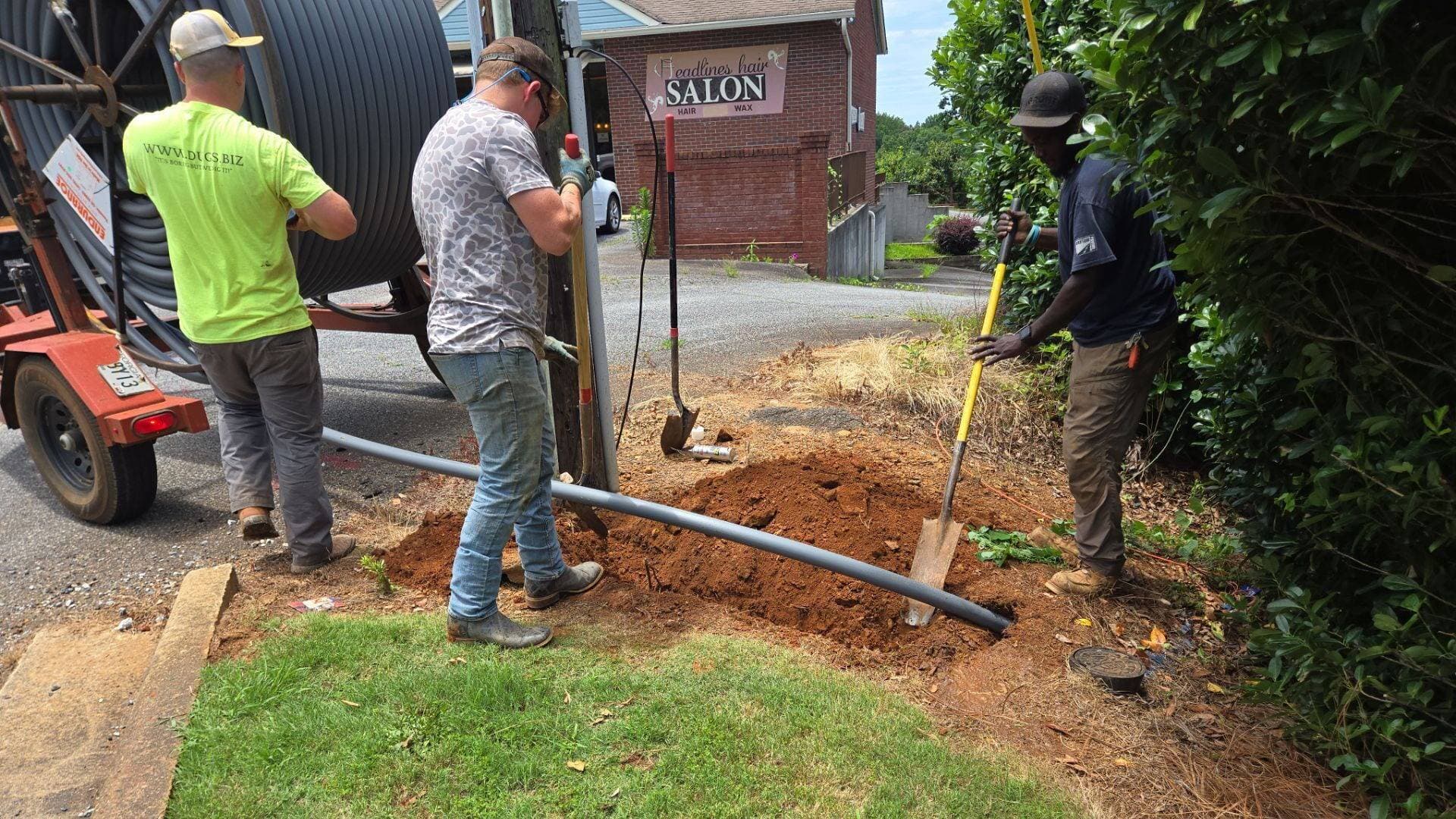
What is directional boring? How a bore day goes, step by step
"What am I actually going to see out there?" is what a superintendent asks once the bore is scheduled. Directional boring looks like nothing from the road: a rig at one end, a pit at the other, someone walking the grass with a receiver. Here is the day in order, and what stops it.
The directional boring sequence, ticket to restoration
Directional boring is a steered pilot hole drilled along a bore path, opened by a reamer in one or more passes, then the product pulled back through the hole. The order never changes: ticket and paint, pothole, pits, pilot, ream, pull, clean up.
We cover the details separately in Fiber optic conduit installation by bore: plan the splices first.
We cover the details separately in Auger boring vs directional drilling for cased road and rail crossings.
The 811 ticket, the paint and the pothole: what happens before the rig moves
Nothing moves until the ticket is in and the paint is down. Georgia 811’s process page puts the request at least 3 business days ahead, and member utilities get at least two full business days after the submit date to mark.
The Georgia Underground Facility Protection Act, posted on Georgia 811’s dig law page, sets the tolerance zone at the width of the facility plus 18 inches on either side, and inside it the excavator must use at least one listed care method, such as hand digging, pot holing, soft digging, vacuum excavation or pneumatic hand tools; other mechanical methods need the facility owner’s approval. The same law names trenchless excavation, HDD included, and requires additional care with it. A ticket is good for 30 calendar days from its effective date.
Potholing, also called daylighting, means opening a hole down to each utility the bore path crosses, by hand or by vacuum excavation (both on the law’s list), to see the pipe and tape its depth. A pothole is proof. OSHA’s excavation standard (1926.651) wants the exact location determined by safe and acceptable means once the work approaches a line.
Good crews pothole the sides of a crossing too, since the line running at an angle to the paint is the one that gets hit. They leave the pothole open until the head has passed under it, so the locator can put the receiver on the actual pipe and the actual head in the same minute. Private lines the public locate never marks are covered in Georgia 811 and utility locating. Paint is the legal floor. The pothole is the plan, and the bid that skipped the potholes is the expensive one.
Pit layout and rig setup on a directional boring job
A directional boring rig wants three things at the entry side: a flat pad for the tracks, room behind it for the rod rack and the mix tank, and a pit in front to catch returns; the JT20 and JT32 rigs in DUGS’s job photos show the layout. The exit side needs its own pit and a straight lay-down lane.
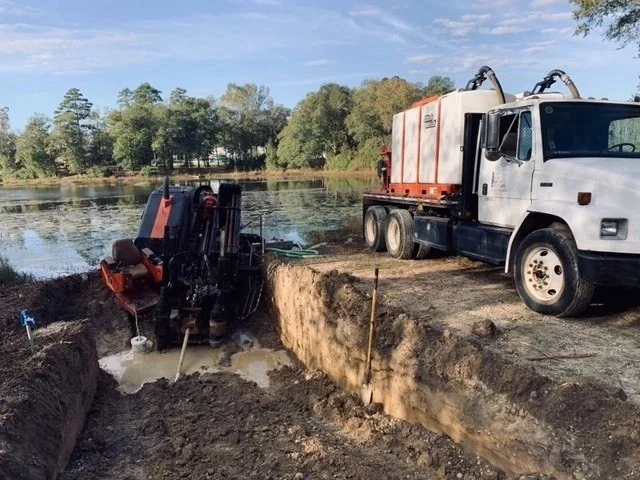
Exit pits for a deep crossing or a vault tie-in get deep fast. OSHA’s protective-system rule (1926.652) requires a protective system (sloping, benching, shoring or a shield box) in any pit 5 feet or deeper unless it is cut entirely in stable rock; under 5 feet, a pit can skip one only if a competent person examines the ground and finds no sign of a potential cave-in. The rule covers anyone who gets in the pit. The specific excavation requirements (1926.651) add a stairway, ladder, ramp or other safe means of egress in any trench excavation 4 feet or deeper, placed so nobody travels more than 25 feet laterally to reach it, and spoil at least 2 feet back from the edge.
The operator sets the entry angle, 20 to 30 percent down per Vermeer’s bore-plan guide, and stakes the rig against thrust. The locator calibrates the receiver to the transmitter at a known distance before the head goes in; skip that and every depth reading is wrong by the same amount, which nobody catches until the exit pit is dry.
The pilot bore: the locator walks ahead of the head
The pilot hole is the one pass in directional boring that is actually steered, with the transmitter riding right behind the bit. The locator walks ahead, finds the head, reads depth and pitch, and calls the next rod to the operator at the rig.
Vermeer’s worked example of a proposed bore plan uses 10‑foot rods, a maximum pitch change of about 10 percent per rod, an entry pitch of minus 25 percent and a target depth of 5 feet. Getting down takes three rods, four run flat, and three bring the head back up: only 40 feet of a 100‑foot bore is level. The plan also holds 1.5 feet of clearance around every utility.
The locator stays ahead so each crossing is checked before the head reaches it. The receiver reads the transmitter behind the bit (the FAQ below gives Vermeer’s numbers), and the locator paints the front and rear locate points and the locate line, usually every rod. A missed reading two rods back is how a bore drifts under a curb line with nobody noticing, so nobody skips a rod.
Rebar in a slab, a chain-link fence or a live primary bends the signal, and no locator can promise a clean reading through it. When it gets shaky the crew slows down and, near a crossing, looks in the open pothole.
Reaming passes and the hole‑size rule of thumb
Once the head is in the exit pit the bit comes off and a reamer goes on, and the rig pulls it back, opening the pilot hole to the size the product needs. Small conduit takes one pass; anything larger takes two or three, each reamer a size up.
PPI’s Handbook of PE Pipe, chapter 12, gives the rule of thumb: normal over-sizing runs 1.2 to 1.5 times the carrier pipe diameter, and its design example reams a 36‑inch hole for a 24‑inch pipe.
A single big reamer in Georgia red clay balls up, drags, and drives the rig’s torque up until something stalls; stepping up one size per pass cuts, and the fluid can actually carry the cuttings out. When the returns at the entry pit thin or stop, the fluid has found somewhere else to go.
Pullback on a swivel, fluid returns and cleanup
Pullback is the last pass of directional boring: pipe or conduit capped with a pulling head and hooked to the reamer through a swivel. The rig pulls the whole train back while the reamer turns and the product does not.
PPI’s chapter describes the swivel as what separates the rotating cutting head from the pipe, and notes that swivels are not 100 percent efficient, so some torque still reaches the pipe; a seized swivel means a twisted, ruined product. Good crews grease it, check it turns free, and pull at a steady speed.
The fluid is drilling mud, which PPI notes can be made from clay or polymers; bentonite is the usual clay. PPI’s chapter lists what it does: reduces torque, holds the hole open, carries cuttings and lubricates the pipe on pullback; losing circulation, it warns, can lock the pipe up during the pull. Returns run back to the entry pit, where the vacuum trailer pulls them out, and the spoil is hauled off under local rules.
Fluid that breaks out to the surface is a frac-out, and the response is stop pumping, contain, vac, then re-plan.
Restoration is two pits backfilled in lifts and the surface put back. The as-built bore log, one reading per rod, goes to the GC; it is the only record of where the directional boring actually put the line.
What stops a directional boring job, and what to have ready
Three things stop directional boring: a line that was not marked, rock the plan did not expect, and fluid that stops coming back. Each is a decision if the crew planned for it, and a lost day if not. Here is the day, stage by stage.
| Stage | What you see on site | What can stop it | The call |
|---|---|---|---|
| 811 ticket and paint | Flags and paint on the bore path | No response from a utility, a ticket past 30 days | Wait it out or re-ticket |
| Potholing | Vac trailer, small holes at each crossing | A line off the paint, a private line nobody mapped | Re-plan the path around it |
| Pilot bore | Locator walking ahead, paint at each rod | Interference, refusal on rock | Slow down, pull back, re-steer |
| Reaming | Reamer pulled toward the rig, mud returns | Lost returns, a hole that will not stay open | Thicken the mud, step the reamer |
| Pullback | Product laid out straight, swivel on | A stuck pipe, a swivel that will not turn | Stop; never over-pull the product |
| Fluid and cleanup | Vac trailer, spoil containers | A frac-out on the surface or in a ditch | Stop pumping, contain, vac |
A dirt head will not steer in solid rock. Cobble shows up differently: the paint trail wanders off the plan, and the crew stops to re-plan the path. Unexpected rock usually means a re-price, covered in what directional boring costs; a test hole beforehand is cheaper than finding out on rod six.
What to have ready on bore day:
- Utility drawings and any private locate, in the crew lead’s hands.
- Entry and exit points staked, lay-down lane clear for the full bore length.
- Water: a hydrant meter or a water truck for the mix tank.
- The permit and traffic control plan on site if the bore crosses a public road.
- Someone reachable by phone for the re-route call when a pothole finds a line off the paint.
Frequently asked questions
Can you bore under a road without closing it?
Usually, yes. Directional boring sets the rig and both pits off the pavement, drills under the road and pulls the product back without cutting the surface, so traffic keeps moving beside the work. FHWA’s manual on reducing pavement utility cuts says trenchless methods share the advantage of reducing the impact to the surface and to pavement structures, and lists reduced impacts to traffic among its benefits. The same section notes that some city ordinances consider directional drilling or microtunneling to be a disruption to the pavement structure, so some cities still require a cut permit for directional boring. A pit, a sign crew or a flagger may take a shoulder or a lane.
How does the crew know where the drill head is underground?
In directional boring the drill head carries a transmitter, often called a sonde, and a locator on the surface reads it with a handheld receiver. Vermeer’s guide to HDD locator systems describes a transmitter about 15 inches long and 1.5 inches in diameter that can be tracked up to 150 feet into a bore, feeding depth, pitch and the head’s roll position to the receiver and to a display on the rig. The locator finds a front locate point and a rear one, walks between them to confirm the head, and paints three marks, usually every rod: the front locate point, the rear locate point and the locate line. That trail of paint is the bore path as drilled.
What is potholing on a directional bore?
Potholing means digging a small hole down to an existing utility so the crew can see it and tape its depth before the drill head passes. NASTT’s trenchless glossary defines it as a small, carefully dug, nonmechanized excavation used to locate a utility or other subsurface feature. On a bore it happens at every crossing, by hand or by vacuum excavation, because paint gives an estimated position and the Georgia 811 Excavator Manual says directional drilling crews must always properly expose each utility crossing.
What happens if the bore hits rock?
What the GC sees first is the rig slowing down. Footage per hour drops, the head gets pulled back, and the crew swaps the soil head for a rock bit or a hammer head; for the reaming passes a different reamer comes off the trailer, and Ditch Witch’s backreamer line includes models built for rock, chunk rock and cobble, with carbide teeth rated from hard, compacted soils through sandstone and shale. Rock the plan never expected usually stops the bore for a re-price conversation with the GC.
What decides how big a pipe a directional boring rig can pull?
The rig does, twice: its class and its pullback rating. Ditch Witch’s guide to choosing a directional drill puts its JT10 class machine at products under 4 inches over roughly 300 feet and its JT120 at a 30‑inch product over more than 1,000 feet. Class is the rough guide; the pullback rating is the hard cap on how hard the rig can pull the product string home, and a longer, heavier string needs more of it. The horizontal directional drilling explainer covers which pipe goes in and how it is sized.
Do you need a permit to bore under a road?
Yes, in nearly every case, because the road and its shoulders are somebody’s right of way. FHWA’s utilities program explains that utilities share highway right of way in the public interest when it does not hurt safety, and that each state writes its rules into an FHWA-approved utility accommodation policy. In Georgia a state-route bore goes through GDOT’s Georgia Permit Application System (GPAS); city and county roads have their own encroachment permits. Who applies varies by project and belongs in the quote. Any lane or shoulder closure needs the traffic control plan the permit calls for.