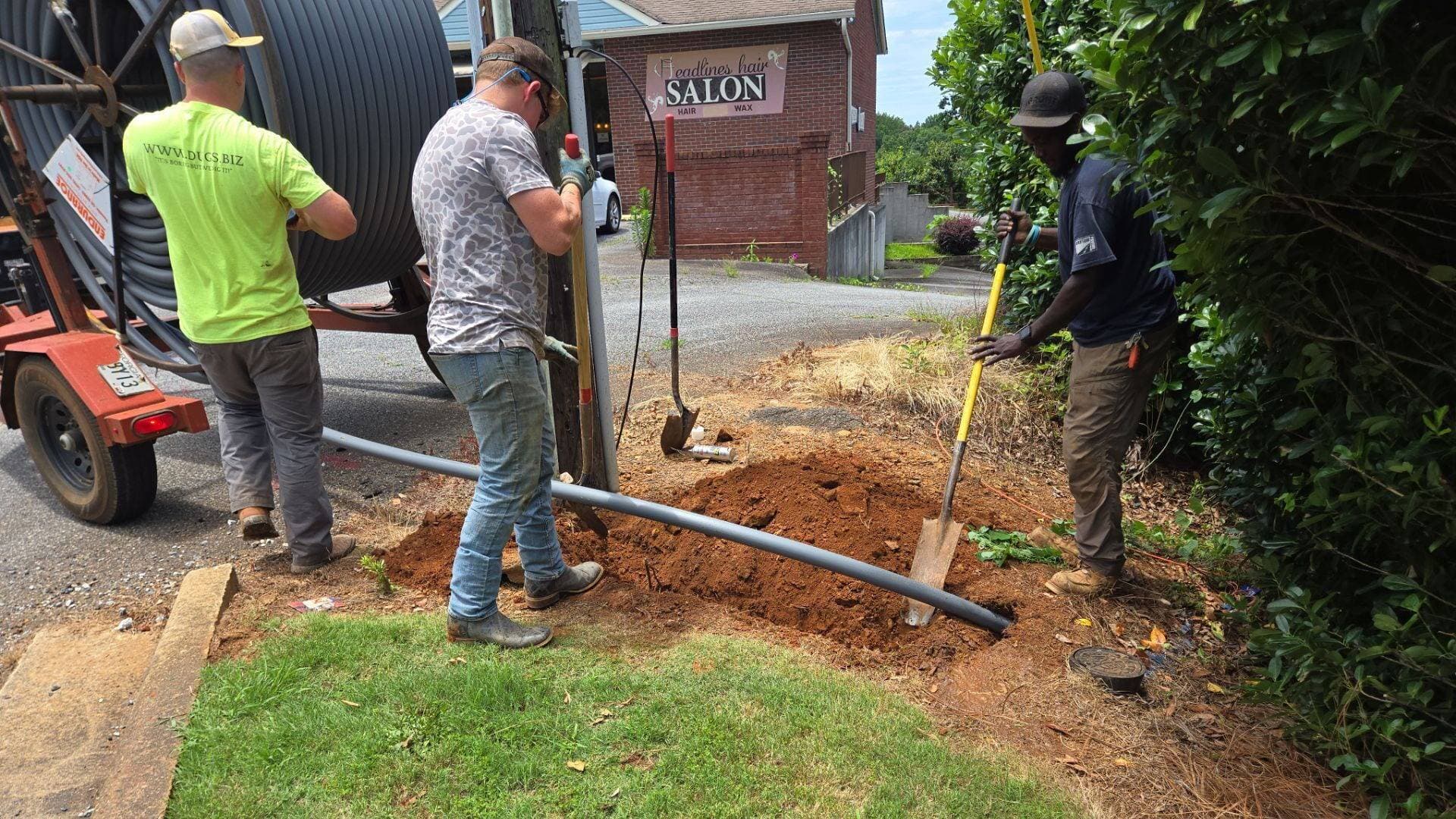
Trenchless pipe installation: choosing HDD, auger boring or a missile
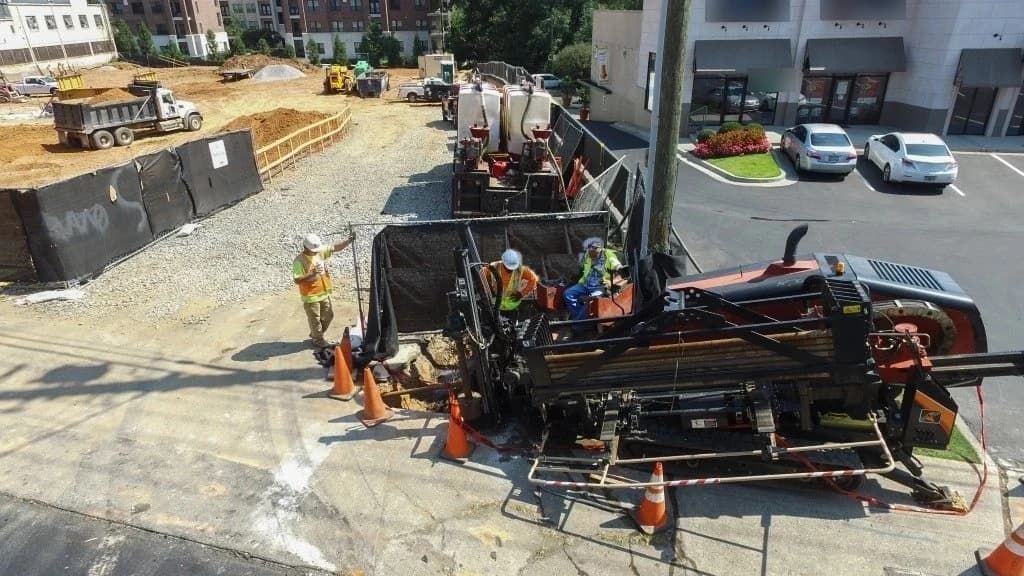
“Can you just bore it?” is the question most site managers ask, and it skips the part that decides the job. Trenchless pipe installation is four machines with four limits, and the drawing picks between them: diameter, shot length, whether the pipe must hold grade, and the soil at bore depth. Pick by those four and the method picks itself. Pick by habit and you pay for a second mobilization.
Trenchless pipe installation starts with four questions on the plan sheet
Method selection for trenchless pipe installation is a reading of the plan sheet, done before anyone talks about rigs. Four questions settle it: the outside diameter, the shot length pit to pit, whether the line must hold grade, and the soil at bore depth. The rest is preference.
Diameter comes first, though the envelopes overlap. From FHWA’s tables and method text, HDD runs 2 to 48 inches, auger boring and open-end pipe ramming 4 to 60, and an impact mole 1 to 3 inches in a single pass, 8 to 10 inches in multiple passes and most commonly up to 12 inches. So diameter mostly strikes the missile off anything bigger than a service line.
Length and grade come next; a gravity sewer rules out the unsteered tools. Soil comes last, and the plan set rarely says what is at 6 feet. The rig is in how horizontal directional drilling works, phase by phase.
The four methods, in the words a crew uses
Four methods cover nearly every utility crossing a Georgia site manager will draw: horizontal directional drilling, auger boring with steel casing, missile boring with a pneumatic piercing tool, and pipe ramming. Microtunneling is a fifth kind of trenchless pipe installation, for big sewer on tight grade, and a job for a tunneling contractor.
Horizontal directional drilling (HDD)
A surface-launched rig drills a steered pilot while a locator walks the sonde above it, then reams and pulls the product back. It bends around things. It runs on bentonite fluid, and a frac-out is that fluid surfacing where nobody planned.
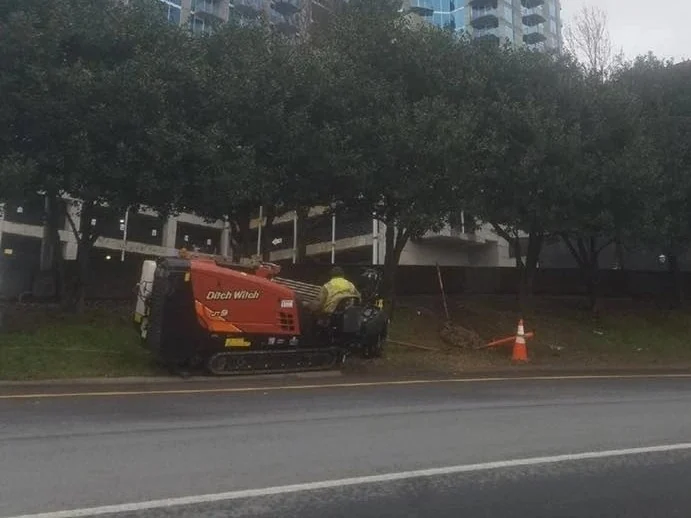
Auger boring with steel casing
Hydraulic jacks push a steel casing off a track in the drive pit while an auger inside carries spoil back (FHWA). Set it to line and grade; past the pit wall you are committed.
Missile boring (pneumatic piercing tool)
An air hammer in a torpedo body that packs soil sideways. The standard tool is unsteered; you aim it in the pit with a sight and a level. Ditch Witch’s HammerHead Mole spec sheet lists more than 29 models from 2 to 5.75 inches, which is a tool range, and its MoleTrac beacon tracks the tool as deep as 10 feet.
Pipe ramming
NASTT defines pipe ramming as a percussive hammer driving an open-end casing through the ground. FHWA rates it for stable or unstable soil, with or without high groundwater, with one catch: an open face needs ground that stands on its own, or soil runs into the pipe.
The trenchless pipe installation decision matrix
The table is the plan-sheet version of installation method selection. Every figure comes from FHWA’s 2002 Manual for Controlling and Reducing the Frequency of Pavement Utility Cuts. Read each as the published range; a given crew may do less.
| Method | Diameter and shot length | Soil, steering and accuracy | Footprint and what stops it |
|---|---|---|---|
| HDD | 2 to 48 in; 600 ft mini, 900 midi, 5,000 maxi | Clay best; gravel risks collapse; steered; proven by the bore log | Surface rig, small pits; stopped by cobbles, boulders, fluid loss |
| Auger boring (jack and bore) | 4 to 60 in casing; up to 890 ft | Cohesive or stable soil; 0.5 in vertical, 1% horizontal with a grade head | Pit 30 to 35 ft long; stopped by rock over a third of the casing, an undrained pit |
| Missile (pneumatic piercing tool) | 1 to 3 in per pass, up to 12 in; 40 to 80 ft, accurate to 32 ft | Compressible soil; unsteered; cover 10x product pipe diameter or 3 to 4 ft, whichever is greater | Two small pits; stopped by solid rock, dense soil, loose sand and gravel |
| Pipe ramming | 4 to 60 in casing; 50 to 200 ft | Wide range of soils; open end needs self-supporting ground, closed face otherwise; 1 to 3% of length | Pit, thrust mat, rails; stopped by large obstacles, spoil weight on long drives |
| Microtunneling (not a DUGS service) | 18 to 60 in; up to 1,500 ft | Remote-controlled, laser-guided | Shafts, slurry plant, control cabin |
Auger accuracy holds with a grade-controlled head; without one, FHWA says, it rides on groundwater, drive length, setup and operator skill, and its table dates from 1997 data. The good crews shoot the track twice before the first push, because the first two sticks set the grade. HDD has no accuracy figure because the figure is the crew’s: a locator reading every rod is the only proof of where the pipe went.
Soil and grade decide more than diameter does
Diameter narrows the list; soil and grade pick the trenchless pipe installation method from it. Sand, clay, cobble and rock each hurt at least one method, and grade removes the unsteered tools from any gravity line.
FHWA calls clay and other cohesive soils best suited for HDD and says HDD generally should not be used in granular soils and gravels, where the hole can collapse, though large rigs now work ground of up to 50 percent gravel. PPI’s MAB-07 table is kinder to sand, rating loose sand above the water table and dense sand below it workable for mini-HDD. The missile has the sand problem: FHWA warns of trouble compacting loose sands and gravels.
FHWA lists wet sand among the soils auger boring handles, so on wet sand, dewatering the pit comes first. Cobble hurts most methods. An auger passes rock up to about a third of the casing diameter per FHWA, and open-end ramming handles cobbly ground better than the other methods.
Grade is where HDD gets oversold. PPI credits better equipment and crew experience for mini-HDD now placing gravity sewer on accurate grade, so ask for the bore log from the last gravity job.
Two design numbers travel with HDD. PPI’s Handbook of PE Pipe chapter on HDD puts reaming over-size at 1.2 to 1.5 times the carrier diameter and says the radius of curvature should exceed 40 times the pipe’s outside diameter. A 12‑inch IPS HDPE line is 12.75 inches outside per that chapter’s tables, so it wants a 15.3 to 19.1 inch hole and a radius of about 42.5 feet. Big crossings get an engineered path, the subject of ASCE’s MOP 108, Pipeline Design for Installation by Horizontal Directional Drilling.
Three trenchless pipe installation scenarios and the pick
Three jobs that land on a Georgia site manager’s desk, worked the way a crew lead would, with the same four questions each time. The pick comes first, because the reason is what the plan reviewer asks for.
A state road crossing for a 12‑inch steel casing
Auger boring. The crossing is short and wants to be dead straight, and the reviewer expects the carrier on spacers. HDD could pull a 12‑inch casing, but into a curved hole 1.2 to 1.5 times its size, and the annulus becomes grout or fluid nobody can inspect. What stops the auger: groundwater that dewatering cannot draw down, or rock over about 4 inches. Then pipe ramming drives the same casing.
GDOT’s Utility Accommodation Policy and Standards Manual sets which lines under a state route get cased, by what they carry, their size and the class of highway, and under Department-owned rail it puts water, gas and sewer in steel casing right-of-way to right-of-way. Clearances, casing lengths and pit setbacks are in auger boring versus directional drilling for cased crossings.
A parking-lot lighting circuit
HDD on a small rig. Say 200 feet of 2‑inch conduit around the islands, under asphalt nobody wants cut. A JT9 or JT20 class rig works it from the surface with pits at the pole bases. We coordinate required 811 notifications before drilling; private lines need their own locate.
A residential driveway water service
A missile. A 1‑inch service under a 20‑foot concrete driveway is what the piercing tool was built for. FHWA’s rule sets the depth at least 10 times the product pipe diameter or 3 to 4 feet, whichever is greater, so 3 to 4 feet here. If the strike turns faster and tinnier, the head is on something hard: reverse and re-aim, not more air. Vermeer’s 15 to 70 feet and FHWA’s 40 to 80 feet describe the same short tool. FHWA also says a mole stays accurate in compactable soil only to about 32 feet, so a longer shot needs check pits along the line or a small HDD rig; see missile boring under driveways and sidewalks.
When open cut is still the right answer
Open cut beats trenchless pipe installation when the trench is short, shallow, in new dirt, and nothing on top is worth protecting. A 40‑foot run across a graded pad at 3 feet of cover is a trench.
For a cased crossing under a state road or rail line, or for any gravity sewer, auger boring is the default and HDD has to argue its way in. Smaller than a casing and longer than a driveway, HDD is the default and the trench has to argue. FHWA adds that trenchless is not appropriate in emergencies, or where soils, rock or uncertainly located utilities preclude it; see directional boring versus trenching, with the numbers.
No trenchless pipe installation promises the pipe lands on the line drawn. Auger boring gets you a straight casing within a tolerance, HDD a logged path, a missile a hole roughly where you aimed. Pick the tolerance the job needs; that is where the boring, trenching and conduit services DUGS runs start.
Frequently asked questions
What is trenchless pipe installation?
Any method that puts a pipe, casing or conduit in the ground without opening a trench along its whole length counts as trenchless pipe installation. FHWA’s guidance on avoiding utility relocations describes trenchless technology as a variety of methods to install, replace, renew or repair underground facilities with minimal surface disruption, and lists directional drilling, auger boring, pipe jacking, microtunneling and pipe bursting among them. For new work the choice is HDD, auger boring with casing, missile boring or pipe ramming.
Which trenchless method is best for a road crossing?
For a road crossing the usual pick is auger boring with a steel casing, because the crossing is short, has to be straight, and the road owner usually wants a casing. FHWA’s sample jack-and-bore specification sizes the steel casing at least 6 inches larger than the largest outside diameter of the carrier pipe. HDD takes over when the crossing is long, needs to curve, or is a small conduit where a casing adds nothing but cost and pit time. Pipe ramming suits cobbly ground, and FHWA notes it is typically used under railways and road embankments.
Which trenchless method is most accurate?
Of the four common trenchless pipe installation methods, auger boring has the tightest published figure. Auger boring holds grade with a grade-controlled steering head; FHWA’s 1997 data puts it at about 0.5 in vertical and 1 percent of length horizontal. Without it, accuracy rides on groundwater, drive length, setup and operator skill. FHWA puts pipe ramming, which is unguided, at 1 to 3 percent of the pipe length, and a missile stays accurate in compactable soil to about 32 feet. HDD is steered, and its line and level can be confirmed on a printout. Tighter sewer work uses the pilot tube method, which NASTT’s glossary defines as a multistage method of accurately installing a product pipe to line and grade.
How far can you bore in one shot?
The method sets the shot limit. A pneumatic piercing tool is the short end; Vermeer’s piercing tool selection guide puts typical missile bores at 15 to 70 feet. Pipe ramming typically runs 50 to 200 feet, and FHWA lists auger boring at up to 890 feet per drive. HDD reaches farthest of the trenchless pipe installation methods: the same manual gives a mini rig up to 600 feet, a midi 900 and a maxi 5,000. On most utility jobs, pit access and the product’s pull strength cap the shot before the rig runs out of rod.
What soil is bad for directional drilling?
Cobbles and boulders stop a small rig; gravel is marginal, and loose gravel can collapse the hole under the reamer. PPI’s MAB-07 guideline for mini-HDD rates gravels and cobbles under 2 to 4 inches as marginal and soils with significant cobbles, boulders or obstructions as a no, while clays, silts, sands and weathered rock rate as workable. Slightly weathered to unweathered rock rates only marginal in the same table, so hard rock needs a rock tool and its own price.
Can pipe ramming go through cobbles?
Yes. Pipe ramming handles cobbly ground better than the other trenchless pipe installation methods. NASTT’s summary of the Oregon DOT pipe ramming study (SPR 710) says ramming allows installation of casings in soils with large cobbles and boulders, ground that may pose greater difficulty to other trenchless techniques. FHWA’s manual adds that an open-ended casing needs less ramming force and is less likely to deflect when it meets an obstacle. Spoil comes out of the casing with air, water or an auger after the drive, per FHWA. A big boulder can still push the casing off line or damage the lead edge of the casing, so the ground investigation comes first.