Directional boring vs trenching: when trenchless saves money
“Is directional boring more expensive than trenching?” Per foot, usually yes. Per finished job, usually no, once the run crosses pavement, a live utility or a lane of traffic. The per-foot rate misses the point of directional boring vs trenching: what the open trench leaves behind, and who pays to put it back.
Directional boring vs trenching: the short answer
The bore costs more per foot because a rig, fluid, tooling and a locator cost more than a trencher and a laborer. The trench usually costs more per job because everything it opens has to be closed again: pavement, sod, compaction, traffic control. Price the job, not the foot.
Six line items decide the call on a plan sheet.
| Line item | Open trench | Directional bore | Usual winner |
|---|---|---|---|
| Cost drivers | Footage, depth, spoil, backfill, box rental | Rig class, diameter, soil, potholes | Trench per foot, bore per job |
| Surface restoration | Saw cut, patch, sod, density tests | Two pits, usually in dirt | Bore |
| Downtime and access | Lane or lot closed until patched | Site stays open | Bore |
| Traffic control | Flaggers or closure through cut and cure | Shoulder or one lane, pits only | Bore |
| Weather sensitivity | Rain floods the cut, OSHA water rules | Rig needs footing | Bore, by less than you think |
| Utility strike risk | Bucket in daylight, spotter can see | Blind head, every crossing potholed | Even, if the potholes get dug |
The trench wins the first row only when the other five are near zero, and on a paved or occupied site they rarely are. Per-foot pricing is covered in what moves a directional boring quote per foot.
There is a full breakdown of this topic in Auger boring vs directional drilling for cased road and rail crossings.
Related reading: What is directional boring? How a bore day goes, step by step.
Directional boring vs trenching on restoration cost
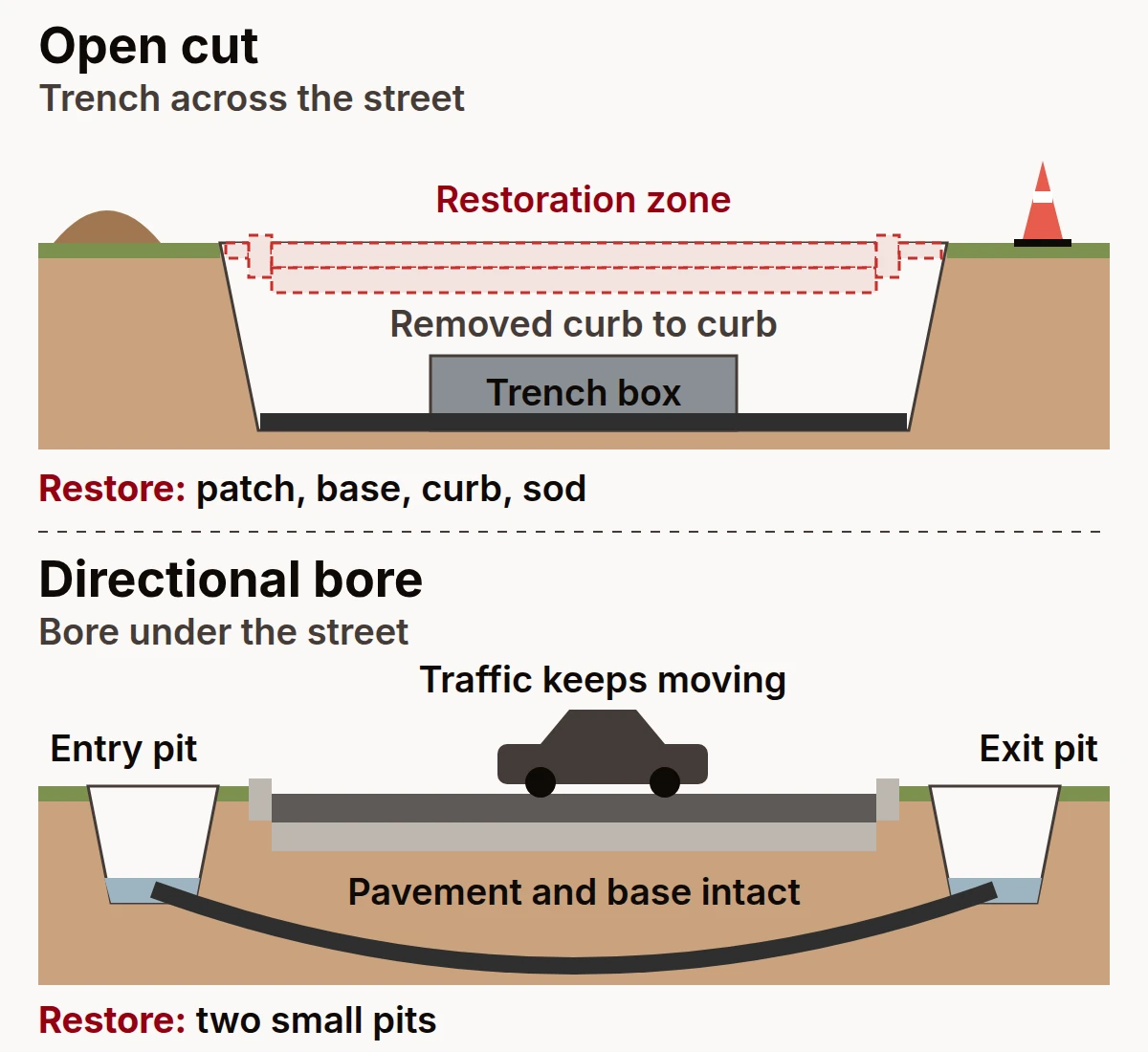
Restoration decides most directional boring vs trenching calls, and it rarely shows up on a per-foot quote. The trench bill is written by what sits on top: asphalt, concrete, curb, sod, irrigation heads. The bore bill is written by two pits.
The FHWA manual’s discussion of the pavement cut problem says it is very difficult, if not impossible, to repair a cut pavement to its original state. The patch ends up wider than the trench, and a saw cut across a concrete driveway leaves a seam that rarely matches.
Below the surface the cost is compaction. Flowable fill costs more per yard than crushed stone and pays for itself the first time a lane reopens the same afternoon. The tell on a cheap open-cut bid is “backfill and compact” with no lift thickness and no test named. Compare how horizontal directional drilling installs a line without a trench.
Trench safety is a real cost under OSHA Subpart P
Safety is where directional boring vs trenching splits widest. Outside stable rock, workers in a trench 5 feet or deeper need a protective system under OSHA’s excavation standard. That means a trench box on a lowboy, a competent person inspecting daily, spoil held at least 2 feet back, and time. A bore’s only trench is the pit.
OSHA’s trenching and excavation safety booklet summarizes 29 CFR 1926 Subpart P. In a trench 4 feet or deeper, a stairway, ladder, ramp or other safe means of egress must be located no more than 25 feet of lateral travel from any worker. Past 4 feet, the air gets tested where oxygen deficiency or a hazardous atmosphere exists or could reasonably be expected to exist. At 5 feet the walls get sloped, benched, shored or shielded before anyone works inside, unless the cut is entirely in stable rock.
Deeper still, Appendix F to OSHA Subpart P on selecting protective systems says protective systems for excavations more than 20 feet deep must be designed by a registered professional engineer. The NIOSH science bulletin on preventing trenching fatalities counts 97 construction-industry trenching deaths from 2013 to 2017. By site type, the same bulletin puts 39 deaths at private residences and 28 on streets and highways: the house lot and the road crossing.
Each rule is a dollar figure. Most bore pits stay under the 5‑foot line, and one exit pit at a deep crossing gets a box, not 300 feet of trench.
Directional boring vs trenching on schedule, traffic control and weather
The trench is faster across an open field and slower across anything with traffic, because the closure lasts until the patch cures. The bore closes only the pit footprint, so traffic control is priced on the pits alone.
FHWA’s trenchless chapter puts a typical HDD installation rate at about 100 meters (328 feet) a day with a skilled crew. A trencher in soft dirt beats that on footage and loses on the calendar: the job is not done until the last lift is compacted, tested, paved and cured. In a public right-of-way both methods usually need the road owner’s written permission. GDOT’s Utility Accommodation Manual requires it before a utility uses or occupies any part of a state right-of-way, and the permit’s restoration and traffic conditions weigh hardest on the cut. For a business that stays open, downtime is often the biggest cost, and it appears on neither quote.
Rain stops the trench long before it stops a bore. Georgia red clay after an inch of rain turns an open trench into a pool that has to be pumped and checked by the competent person before anyone steps back in. A saturated site still needs matting for the rig, so the bore’s edge is smaller than the brochures say.
Directional boring vs trenching and the risk to existing utilities
Both methods can hit a line. The trench hits it with a bucket in daylight, where a spotter can see the soil change. The bore hits it with a head nobody can see, which is why a bore crew potholes every crossing.
The Common Ground Alliance’s DIRT report release for 2019 estimated about 532,000 excavation-related damages to underground facilities that year, up 4.5 percent from 2018, with a societal cost of roughly $30 billion.
The Georgia Underground Facility Protection Act binds both methods. The person planning the excavation files the locate request. The notice period runs at least two full business days and no more than eight, counted from 7:00 a.m. on the first business day after Georgia 811 receives the ticket. Georgia 811’s process page asks for at least 3 business days; that is guidance, not the statute. Work starts sooner only if every identified owner has responded in PRIS that its facilities are not in conflict or have been marked. A ticket covers 30 calendar days from its effective date.
We coordinate 811 notices before drilling and plan the bore path around the marks. The tolerance zone is the facility’s width plus 18 inches on either side of its outside edge, measured horizontally. Inside the tolerance zone, the Act requires reasonable care, including at least one of hand digging, pot holing, soft digging, vacuum excavation, pneumatic hand tools or other technical methods. On a trench job that usually means hand digging, the step crews bend late in the day. For the bore, the Georgia 811 Excavator Manual says directional drilling crews must always properly expose each utility crossing.
Where open cut still wins, and the rule for the plan sheet
Most directional boring vs trenching calls go to the bore, with four exceptions: short shallow runs in dirt with nothing to restore, raw subdivisions where utilities share one joint trench, very large diameter and gravity sewer that must hold grade, and heavy gravel or cobble. On those, open cut usually wins.
The FHWA chapter is blunt about ground: where the investigation finds granular soils and gravels, HDD generally should not be used, though large rigs now work in formations of up to 50 percent gravel. The latest equipment is reported to allow gravity pipelines that demand close tolerances in vertical alignment, yet many owners still spec a gravity sewer on a two-tenths grade as an auger bore or laser-set trench; the guide to choosing between trenchless pipe installation methods covers that choice.
Four questions settle directional boring vs trenching on a plan sheet:
- Does the run cross pavement, concrete, sod or a lot in use? Bore.
- A live utility, a road with traffic, a property that stays open? Bore, and pothole every crossing.
- Gravity flow on a tight grade, oversize pipe, heavy gravel and cobble? Open cut or auger boring.
- Short, shallow, in dirt, nothing on top? Trench it.
When those four leave the directional boring vs trenching call open, count the days the surface will be open and price them at what the owner loses. When the run needs a bore, here is what a bore quote covers.
Frequently asked questions
Is directional boring more expensive than trenching?
Per foot, directional boring usually costs more than trenching, because a rig, fluid, tooling and a locator cost more than a trencher and a laborer. Per finished job it often flips, because the trench bill carries everything the cut opened: patching, sod, compaction and traffic control. The FHWA manual on controlling pavement utility cuts describes degradation fees and jurisdictions that waive them or ease requirements for trenchless work. The same page notes that “in many cases trenchless technology is still more expensive than traditional trenching, especially in urban and suburban areas,” which is why the manual suggests fee waivers as an incentive. A run that crosses pavement is usually cheaper bored.
When is trenching better than boring?
Trenching is the better choice on a short, shallow run in dirt with nothing on top to restore, on a raw subdivision where several utilities share one joint trench, on very large diameter pipe or gravity sewer that must hold a precise grade, and in heavy gravel or cobble. OSHA’s protective systems rule, 29 CFR 1926.652, does not require a protective system when an excavation is less than 5 feet deep and a competent person has examined the ground and found no indication of a potential cave-in.
Which method is faster, boring or trenching?
It depends on what sits on top. On raw footage in open dirt, a trencher is usually faster. Where the surface has to go back, the bore finishes first, because the trench is not done until the backfill is compacted, tested, patched and cured. The FHWA chapter on trenchless technology for pavement cuts gives a typical HDD installation rate of about 100 meters (328 feet) a day with a skilled crew, and the bore leaves only two pits to close.
Can you bore under a driveway without cracking it?
Yes. A driveway bore keeps the drill head well below the slab, and bentonite drilling fluid holds the reamed hole open, so no ground under the slab is dug out. NASTT’s Trenchless 101 glossary describes HDD as a surface-launched method: a pilot bore along the design path, reamed to suit the product, which is pulled in last. The risks are too little cover depth, an oversized reamer or excess fluid pressure heaving the slab or causing a frac-out, where drilling fluid breaks out to the surface. Ask for the planned depth under the slab.
Is trenchless safer for existing utilities?
It is safer when the crew potholes every crossing and runs a locator ahead of the head, and no safer when it does not, because the bore head is blind. The Common Ground Alliance’s 2024 DIRT report release analyzed 196,977 unique damage reports for 2024 and found the top ten root causes behind 85 percent of them. The bid line that decides it is a pothole at every crossing, dug and exposed on all sides before the drill head reaches it.
How much pavement does trenching disturb?
More than the trench width. A proper patch is a T-cut: the saw runs past the excavation on each side so the new asphalt keys into undisturbed base, so a 2‑foot trench becomes a patch several feet wide, plus any milling and overlay the road owner requires. The FHWA pavement utility cuts manual reports that the District of Columbia logged over 5,000 utility cuts during 1996, covering over one percent of its total pavement surface. A bore disturbs only two pit footprints.