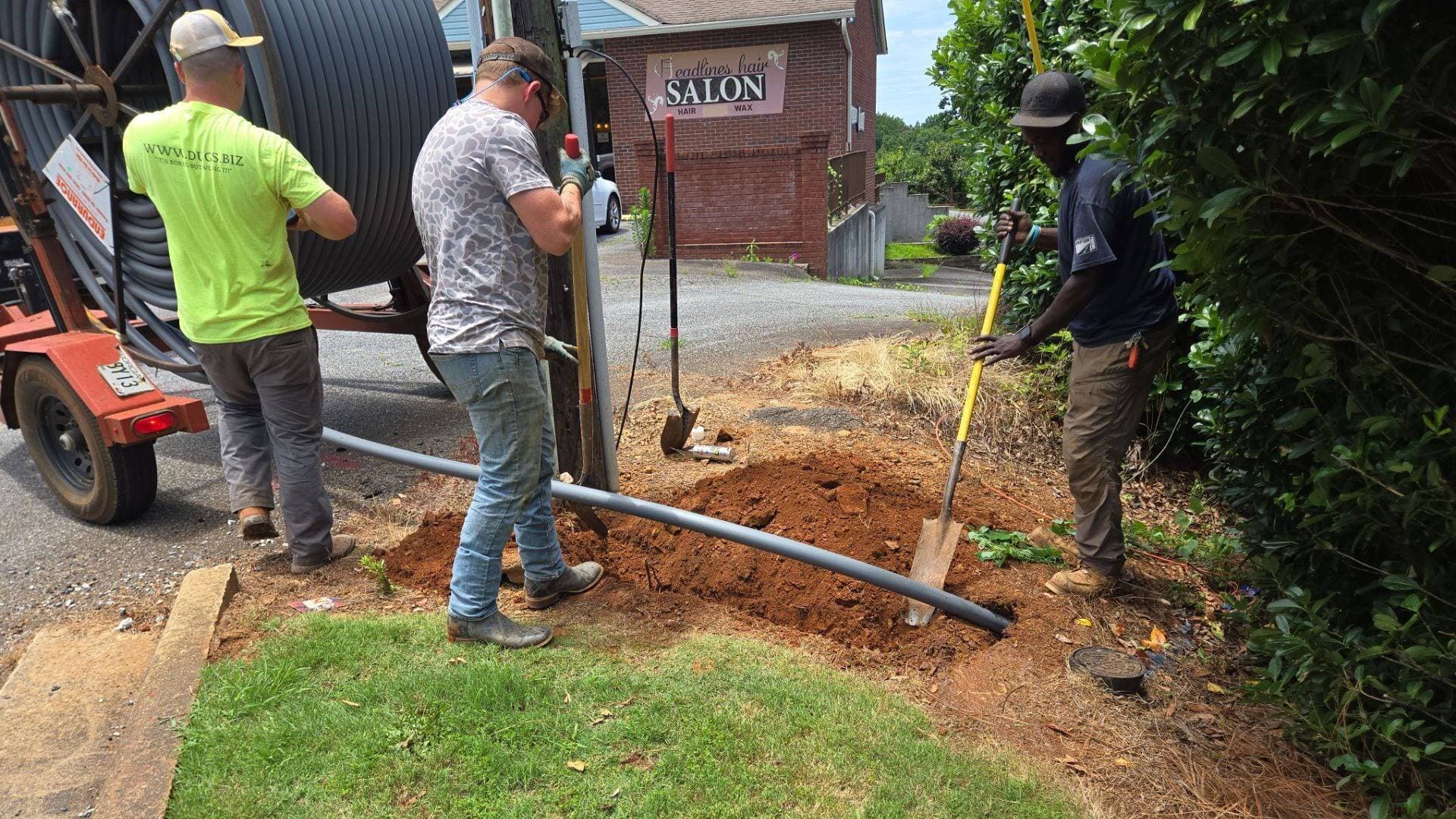
Horizontal directional drilling explained: rig, phases and limits
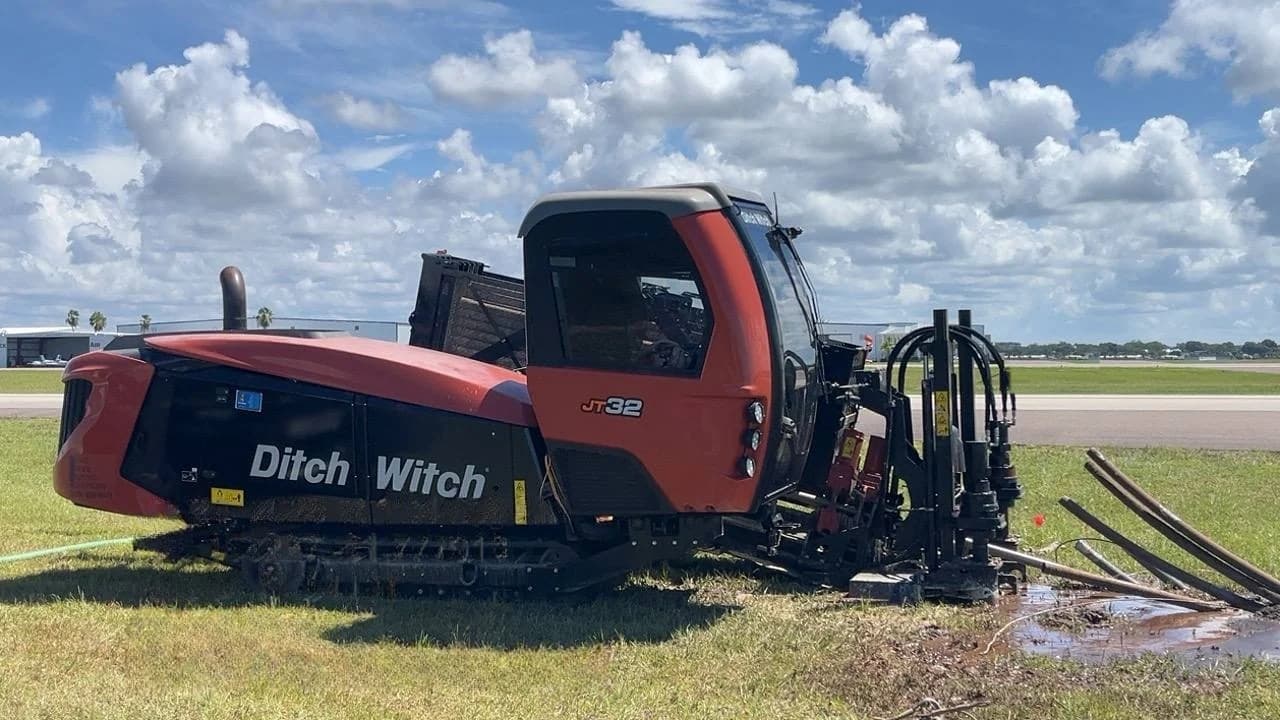
“Can you get a 4‑inch conduit under the road without cutting it?” The answer is usually yes. Horizontal directional drilling puts pipe, conduit and cable under a road, a driveway or a creek from a rig on the surface, with a pit at each end. It is the workhorse of utility work, and the wrong tool for some crossings.
Horizontal directional drilling, defined the way the trade uses it
Horizontal directional drilling (HDD) is a surface-launched trenchless installation method for pipe, conduit and cable along a planned path. NASTT’s Trenchless 101 glossary defines it as a pilot bore along the design pathway, reamed in one or more passes to suit the product, then pulled into the prepared bore.
Directional boring is the small-rig version; HDD, or directional drilling, is the same method at any scale. PPI’s Handbook of PE Pipe draws the line at rig class: mini-HDD rigs handle pipe up to 10 or 12 inches, maxi-HDD rigs pipe as large as 48 inches with pullback forces of several hundred thousand pounds. For the bore day itself, read how a directional bore day actually goes.
We cover the details separately in Auger boring vs directional drilling for cased road and rail crossings.
The rig and the tooling on a horizontal directional drilling job
An HDD drilling spread is a rig, a rack of drill rod, a steerable head, a surface locator, reamers and a swivel, a mud system with tank and pump, and a vacuum excavator for potholing and picking up returns. Each piece belongs to one phase.
- The rig. Thrust and pullback are its two numbers; Ditch Witch’s JT20 spec sheet lists 17,000 pounds of thrust and 20,000 of pullback.
- Drill rod. Threaded steel joints added one at a time; PPI notes the rod usually limits the bend radius before the pipe does.
- Drill head and sonde. A slanted-face bit steers when pushed without rotation and drills straight when rotated. The sonde behind the bit transmits pitch, roll, temperature and battery status; the receiver works out depth from signal strength.
- Walkover locator. The handheld receiver that reads the sonde. The Florida DOT specification in FHWA’s sample trenchless specifications wants clock and pitch, depth, transmitter temperature, battery and position, with readings recorded every five feet.
- Reamers and swivel. The back reamer opens the hole on the way back; the swivel keeps rotation off the pipe.
The locator is the job. The operator cannot see the head; the person with the receiver can, and only at the moment of a reading. Good crews take depth and pitch at every rod and call it back before the next rod goes in. Crews that read only when the display flags something steer blind for a rod’s length.
The three phases: pilot bore, pre-ream, pullback
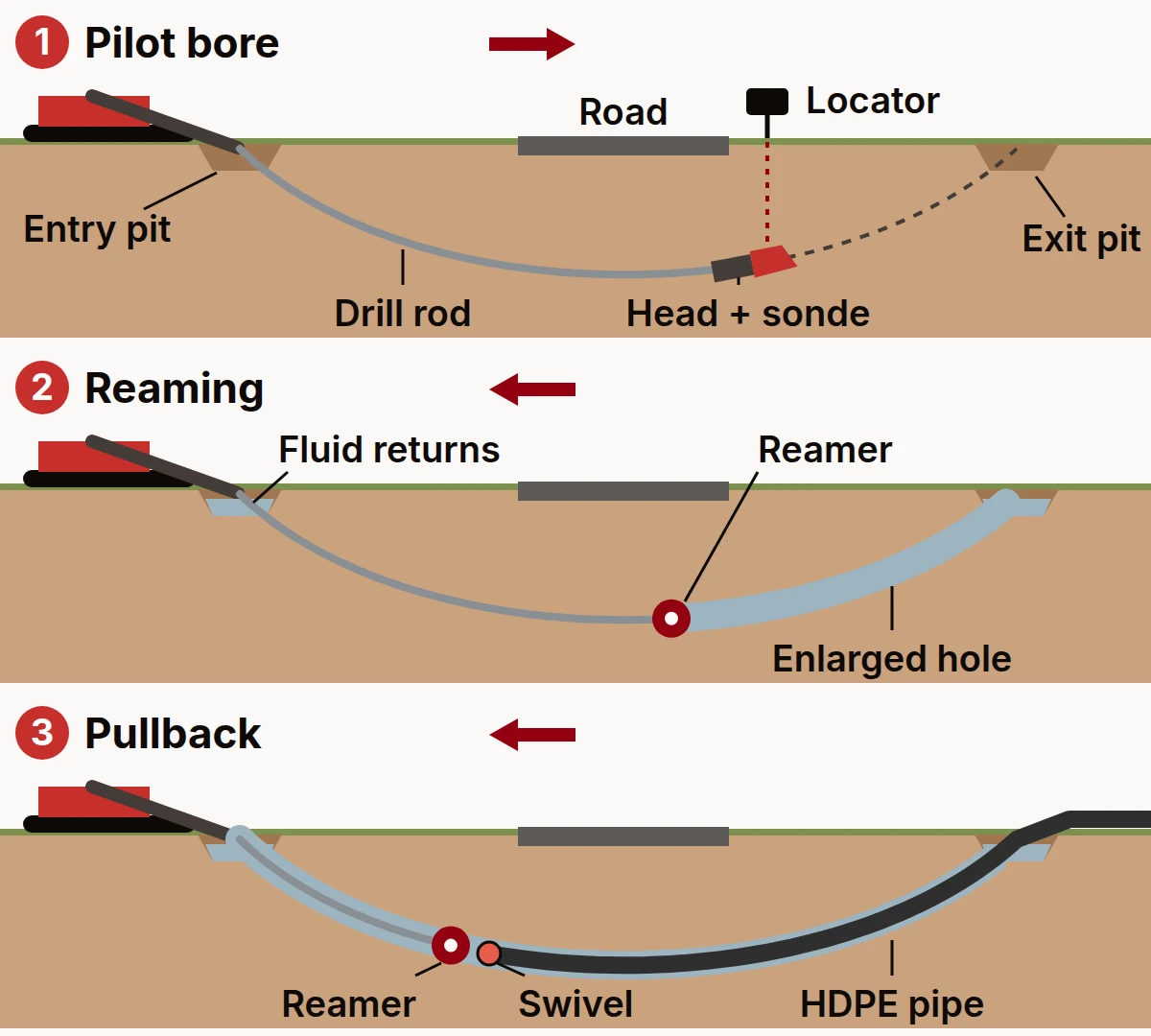
Every HDD installation is three operations: a steered pilot bore, reaming passes that open the pilot to a hole larger than the product, and the pullback, where the product follows a reamer and swivel into the hole. PPI calls pilot hole reaming the key to a successful project.
Pilot bore
The head goes in at an angle, runs flat under the crossing and climbs to the exit pit; the FDOT specification calls that an inverted arc. PPI’s advice: choose entry and exit points for the largest radius the right-of-way allows, keep them within 50 feet of the same elevation, and avoid dog-legs, which add pullback load. Ditch Witch’s spec sheets list a 10 to 14 degree entry angle for the JT20 and 9 to 20 degrees for the AT32; the flatter the entry or the deeper the crossing, the farther back from it the rig sets up.
Pre-ream
PPI puts normal reaming oversize at 1.2 to 1.5 times the carrier pipe diameter. The FDOT specification caps the back-ream hole by nominal size: no more than 4 inches for 2‑inch pipe, 8 inches for 4‑inch, 14 inches for 10‑inch, and product OD plus 6 inches from 12 inches up.
The pass the cheap crews skip is the swab pass: the production-size reamer run once more with nothing behind it to clear clay clumps and pack the wall. Skip it and the product hangs on a clump halfway.
Pullback
Pullback is one continuous pull: reamer, swivel, product. PPI puts pullback speed at 1 to 2 feet per minute. Tension matters because polyethylene weakens the longer it is loaded; PPI’s safe pull stress for PE4710 at 73°F is 1,500 psi at half an hour and 1,100 psi at 24 hours. A pull that stalls overnight costs more than time: the allowable stress dropped while it sat.
Drilling fluid: what the bentonite does and what a frac-out is
HDD drilling fluid is water carrying bentonite clay, sometimes with polymers, soda ash or surfactants; NASTT calls the treated version engineered drilling fluid. PPI lists its jobs: cut torque, hold the hole open, suspend cuttings, build a filter cake on the wall, and lubricate the pull.
The FDOT specification sizes the pits to hold the expected returns, and return is the word to watch. Fluid that comes back to the pit is working. Fluid that stops coming back has gone into the ground, which NASTT calls an inadvertent return; when it beats the ground’s strength and reaches the surface or a waterway, it is a hydrofracture.
Hard or acidic mix water will not yield bentonite, so good crews test calcium and pH first and add soda ash, which treats both, before the clay. When returns stop, they stop pushing and pull back a rod; PPI warns that lost circulation can lock the product in the hole.
Design constraints of horizontal directional drilling: cover depth, bend radius, soil
Four things set the shape of a horizontal directional drilling path: cover, the bend radius of rod and pipe, the soil, and what is already buried in the corridor. The table has the numbers a reviewer asks for.
| Constraint | What sets it | Number |
|---|---|---|
| Cover under traffic | Live load, fluid | 18 in or one pipe diameter, whichever larger (PPI) |
| Borehole oversize | Soil, depth, fluid | 1.2 to 1.5 times pipe diameter (PPI) |
| Bend radius | Rod first, then pipe | Over 40 times pipe OD (PPI example) |
| Entry and exit elevation | Pullback load, fluid head | Difference under 50 ft (PPI) |
| Tolerance zone | Georgia law | Facility width plus 18 in either side (Georgia 811) |
| Pit cave-in protection | OSHA 1926.652 | Needed at 5 ft or deeper unless stable rock (OSHA) |
PPI puts pipe under vehicle loads at least 18 inches or one pipe diameter below the road surface, and adds that HDD pipe generally goes deeper to keep the fluid from surfacing. Depth also has to be reachable: a deep crossing needs run on each side to dive and climb inside the bend radius, so a short driveway cannot go deep.
Bend radius follows the rod first, then the pipe: PPI cites SDR 11 polyethylene cold-bending to 25 times its outside diameter and uses 40 times OD as the floor in its example. Clay steers well but packs a reamer. Sand drinks fluid. Cobble deflects the head and wrecks the plan.
PPI says to locate every buried structure within 10 feet of the path for mini-HDD and 25 feet for maxi-HDD. The Georgia Underground Facility Protection Act, as posted by Georgia 811, sets the tolerance zone at the facility width plus 18 inches either side, requires reasonable care inside it, such as hand digging, potholing, soft digging or vacuum excavation, and limits work to 30 calendar days after a locate request’s effective date; after that, a new ticket.
We coordinate required 811 notifications and plan the bore path around existing infrastructure. Pits and potholing may still be required; OSHA’s excavation standard, 1926.652, requires cave-in protection in pits 5 feet or deeper unless in stable rock.
Where HDD wins, and where it loses
HDD wins wherever the surface is worth more than the trench: pavement, finished landscaping, a live driveway, a creek, a rail or highway crossing. It loses in solid rock on a standard utility rig, under shallow cover, at very large diameter, and on gravity sewer that must hold grade.
Shallow cover invites frac-outs; use a piercing tool or a trench. Above PPI’s 10‑to‑12‑inch mini-rig line, fluid volume and pullback force climb, and a cased highway or railroad crossing often goes to auger boring for line and grade; the picks are in how a site manager chooses between HDD, auger boring and missile boring.
A general contractor should stop specifying open cut by default on any run that crosses pavement, a live driveway, established landscaping or a road that needs closing. Priced with restoration and traffic control, the trench loses to a horizontal directional drilling bore on most of those crossings; the worked comparison is in directional boring versus trenching, and FHWA’s manual on pavement utility cuts points the same way: it recommends trenchless where possible and practical. Open cut keeps runs with nothing to restore, such as new site work; see the DUGS services list.
Horizontal directional drilling glossary: 13 terms
Horizontal directional drilling runs on a short vocabulary: pilot bore, reamers, bentonite fluid and pullback, plus the sonde and locator that track the head. These 13 terms are the ones a bore plan and a bore log use, worded after NASTT or PPI.
- Horizontal directional drilling (HDD)
- Surface-launched trenchless method: pilot bore, reaming, pullback. Called directional boring at utility scale.
- Pilot bore
- The first, small hole drilled along the planned path; it fixes line and depth for everything after.
- Sonde
- The battery transmitter behind the bit; it sends pitch, roll, temperature and battery status, and the locator reads depth from its signal.
- Walkover locator
- The handheld receiver carried above the bore to read the sonde against the plan.
- Drill rod
- Threaded steel joints added one at a time to push the head and pull the product.
- Back reamer
- Per NASTT, a cutting head on the drill string that enlarges the pilot bore during pullback.
- Swab pass
- A final pass with the production-size reamer and nothing behind it, to clean the hole before pullback.
- Swivel
- A bearing between reamer and product that lets the drill string rotate without twisting the pipe.
- Pullback
- The last phase: reamer, swivel and product pulled through in one run, at 1 to 2 feet per minute per PPI.
- Bentonite
- Per NASTT, a colloidal clay that forms a slick slurry or gel when water is added; also called driller’s mud.
- Filter cake
- Per NASTT, a thin layer of clay or polymer from the slurry at the face and perimeter of the hole.
- Drilling fluid
- Per NASTT, water that may carry bentonite, polymers, soda ash or surfactants.
- Inadvertent return (frac-out)
- Per NASTT, loss of drilling fluid from the system; fluid that reaches the surface or a waterway is a hydrofracture or frac-out.
Frequently asked questions
How deep can horizontal directional drilling go?
The design sets the number. PPI’s Handbook of PE Pipe puts pipe under traffic at least 18 inches or one pipe diameter below the road surface, whichever is larger, and says HDD pipe generally goes deeper to keep drilling fluid down. Beyond that, bend radius and the run available to dive and climb set the limit. For a major crossing the engineer works from MOP 108, Pipeline Design for Installation by Horizontal Directional Drilling, listed in ASCE’s pipelines engineering manual package.
What pipe can be installed with HDD?
Almost anything that can take a pull. NASTT’s glossary definition of horizontal directional drilling lists pipes, conduits and cables. In utility work that means fused HDPE for water, gas and electrical conduit, fusible PVC where the owner specifies it, steel casing where a road authority wants a sleeve, and fiber in innerduct, microduct or fabric innerduct. Polyethylene is the default for trenchless installation because the whole string is fused into one piece and bends with the bore. PPI’s chapter puts mini-HDD at pipe up to 10 or 12 inches and maxi-HDD rigs at up to 48 inches.
Is HDD safe near existing utilities?
Horizontal directional drilling is as safe as the locating before it, and no safer. The bore plan comes from 811 markings, private locates and a pothole at every crossing, which the Georgia 811 Excavator Manual requires for directional drilling. Georgia’s Underground Facility Protection Act sets the tolerance zone at 18 inches either side of a line’s outer edge and requires reasonable care inside it, such as hand digging, potholing or vacuum excavation. A bore that crosses a marked line without a pothole is a guess.
How long does a directional bore take?
The bore itself is usually the short part. PPI’s handbook puts pullback speed at 1 to 2 feet per minute, so a few hundred feet of product goes in over a few hours after the pilot and reaming passes, and a small utility bore often takes a day or two. The schedule is set earlier: Georgia 811’s locate process says to submit the ticket at least 3 business days before digging, and utility members have at least two full business days after the day of submission to mark. Rock or fluid loss can add days.
What is the difference between HDD and directional boring?
Nothing in the method; the difference is scale and who is talking. Directional boring is the utility trade’s name for small-rig work: driveways, parking lots, a few hundred feet of conduit on a machine such as the Ditch Witch JT20, whose spec sheet lists 20,000 pounds of pullback. Horizontal directional drilling, or HDD, is the same process at any scale, up to river crossings on maxi rigs with pullback in the hundreds of thousands of pounds, per PPI’s handbook.
Does HDD work in rock?
Yes, with different tooling and a slower day. A standard utility rig with a slanted-face bit steers by pushing against soil; on a hard rock face it walks off or stops. Rock takes a rock bit or a downhole mud motor, or a dual-rod all-terrain rig such as the Ditch Witch AT32, which its spec sheet rates at 32,000 pounds of thrust and pullback. Expect fewer feet per day and more wear on bits and reamers. Cobble and boulders are often worse than solid rock, because the head deflects off each one and the pilot wanders.